Friday, November 11, 2005

Iraq Archive

Online Resources

Iraqanalysis.org
Morbidity and Mortality Among Iraqi Children from 1990 Through 1998: Assessing the Impact of the Gulf War and Economic Sanctions
Brookings Institution:Iraq
C-SPAN Iraq Coverage

Blogs that Discuss Iraq

Back to Iraq 2.0
Daily Howler
Brad DeLong
Political Animal/Kevin Drum
Talking Points Memo/Joshua Micah Marshall
Nouriel Roubini's Global Economics Weblog
MaxSpeak,You Listen!
TAPPED

Debate Chronology/Meta-Narrative

2002

9/7
White House: Bush Misstated Report on Iraq
An MSNBC article mysteriously taken down recovered by The Memory Hole.
10/22
For Bush, Facts Are Malleable
Dana Milbank enumerates several Bush falsehoods in the Washington Post.
10/25
Dead Parrot Society
Paul Krugman expands on Milbank’s emphasis on Iraq to recapsulate mendacity going back to the election of 2000.
11/6
Malleable Facts
The Dubya Report goes so far as to chart the Bush falsehoods from the Milbank article.

2003

4/17
Where Are Saddam's Weapons of Mass Destruction?
Brad Delong asks.

4/29
Matters of Emphasis
Paul Krugman on the Bush Administration’s hype of the Iraqi threat.
5/1
All the President’s Lies
Contrasts Bush’s rhetoric with the actual content of his policies.
5/13
The Say-Anything School
EJ Dionne updates Bush Administration misinformation.
5/14
Intelligence Designed
Harold Meyerson details Bush Administration end-runs around bureaucratic channels to derive the desired intelligence product.
5/15
WMD? MIA
David Corn of the Nation decries what he sees as the Bush Administration’s dangerously lackadaisical search for WMD.
6/1
Bush Remarks Confirm Shift in Justifying War
Dana Milbank on Bush’s downshifting claims on Iraq. From the Washington Post.
6/3
The Truth About Bush’s “Lies”
Byron York of the National Review defends Bush.
6/10
Who's Accountable?
Paul Krugman on the failure of the Bush Administration to account for previous claims.
6/19
The Selling of the Iraq War. The First Casualty.
A cumulative accounting of the Bush Administration’s ministrations of intelligence regarding Iraq by Spencer Ackerman and John Judis in The New Republic.
6/24
Denial and Deception
Paul Krugman on the response – or lack thereof – to the Bush Administration’s spin on its case for war.
6/26
Pants on fire...
The Likely Story compiles Bush lies about Iraq.
6/27
Was Bush Lying About WMD?
Fred Kaplan makes a case for misreading of the evidence.
6/29
Is Bush Lying About Iraq?
Orcinus makes a case.
6/30
The War Against Bush
Stephen Hayes of Rupert Murdoch’s Weekly Standard responds to the Ackerman/Judis piece.
10/1
Unilateralism Disgraced
In the American Prospect, Ivo H. Daalder of Brookings and James M. Lindsey of the Council on Foreign Relations on Bush's wrong unilateral assumptions on Iraq.
11/17
WAR AFTER THE WAR
George Packer in The New Yorker on the chaos which led to the chaos.

2004

2/8
Vial Mendacity [originally posted at Suite101.com]
8/7
Who Parses the Parsers?
Paul Krugman writes in to Matthew Yglesias.
10/26
Security in Iraq
Ivo Daalder, Zbigniew Brzezinski, and Max Boot on The Diane Rehm Show.
10/29
Lancet Report 'Mortality before and after the 2003 invasion of Iraq'

The Lancet study and related links at Iraqanalysis.org

2005

5/1
Blair hit by new leak of secret war plan
London Times reporting on how the war decision preceded justification.

The secret Downing Street memo:


SECRET AND STRICTLY PERSONAL - UK EYES ONLY


DAVID MANNING
From: Matthew Rycroft
Date: 23 July 2002
S 195 /02

cc: Defence Secretary, Foreign Secretary, Attorney-General, Sir Richard Wilson, John Scarlett, Francis Richards, CDS, C, Jonathan Powell, Sally Morgan, Alastair Campbell

IRAQ: PRIME MINISTER'S MEETING, 23 JULY

Copy addressees and you met the Prime Minister on 23 July to discuss Iraq.

This record is extremely sensitive. No further copies should be made. It should be shown only to those with a genuine need to know its contents.

John Scarlett summarised the intelligence and latest JIC assessment. Saddam's regime was tough and based on extreme fear. The only way to overthrow it was likely to be by massive military action. Saddam was worried and expected an attack, probably by air and land, but he was not convinced that it would be immediate or overwhelming. His regime expected their neighbours to line up with the US. Saddam knew that regular army morale was poor. Real support for Saddam among the public was probably narrowly based.

C reported on his recent talks in Washington. There was a perceptible shift in attitude. Military action was now seen as inevitable. Bush wanted to remove Saddam, through military action, justified by the conjunction of terrorism and WMD. But the intelligence and facts were being fixed around the policy. The NSC had no patience with the UN route, and no enthusiasm for publishing material on the Iraqi regime's record. There was little discussion in Washington of the aftermath after military action.

CDS said that military planners would brief CENTCOM on 1-2 August, Rumsfeld on 3 August and Bush on 4 August.

The two broad US options were:

(a) Generated Start. A slow build-up of 250,000 US troops, a short (72 hour) air campaign, then a move up to Baghdad from the south. Lead time of 90 days (30 days preparation plus 60 days deployment to Kuwait).

(b) Running Start. Use forces already in theatre (3 x 6,000), continuous air campaign, initiated by an Iraqi casus belli. Total lead time of 60 days with the air campaign beginning even earlier. A hazardous option.

The US saw the UK (and Kuwait) as essential, with basing in Diego Garcia and Cyprus critical for either option. Turkey and other Gulf states were also important, but less vital. The three main options for UK involvement were:

(i) Basing in Diego Garcia and Cyprus, plus three SF squadrons.

(ii) As above, with maritime and air assets in addition.

(iii) As above, plus a land contribution of up to 40,000, perhaps with a discrete role in Northern Iraq entering from Turkey, tying down two Iraqi divisions.

The Defence Secretary said that the US had already begun "spikes of activity" to put pressure on the regime. No decisions had been taken, but he thought the most likely timing in US minds for military action to begin was January, with the timeline beginning 30 days before the US Congressional elections.

The Foreign Secretary said he would discuss this with Colin Powell this week. It seemed clear that Bush had made up his mind to take military action, even if the timing was not yet decided. But the case was thin. Saddam was not threatening his neighbours, and his WMD capability was less than that of Libya, North Korea or Iran. We should work up a plan for an ultimatum to Saddam to allow back in the UN weapons inspectors. This would also help with the legal justification for the use of force.

The Attorney-General said that the desire for regime change was not a legal base for military action. There were three possible legal bases: self-defence, humanitarian intervention, or UNSC authorisation. The first and second could not be the base in this case. Relying on UNSCR 1205 of three years ago would be difficult. The situation might of course change.


The Prime Minister said that it would make a big difference politically and legally if Saddam refused to allow in the UN inspectors. Regime change and WMD were linked in the sense that it was the regime that was producing the WMD. There were different strategies for dealing with Libya and Iran. If the political context were right, people would support regime change. The two key issues were whether the military plan worked and whether we had the political strategy to give the military plan the space to work.

On the first, CDS said that we did not know yet if the US battleplan was workable. The military were continuing to ask lots of questions.

For instance, what were the consequences, if Saddam used WMD on day one, or if Baghdad did not collapse and urban warfighting began? You said that Saddam could also use his WMD on Kuwait. Or on Israel, added the Defence Secretary.

The Foreign Secretary thought the US would not go ahead with a military plan unless convinced that it was a winning strategy. On this, US and UK interests converged. But on the political strategy, there could be US/UK differences. Despite US resistance, we should explore discreetly the ultimatum. Saddam would continue to play hard-ball with the UN.

John Scarlett assessed that Saddam would allow the inspectors back in only when he thought the threat of military action was real.

The Defence Secretary said that if the Prime Minister wanted UK military involvement, he would need to decide this early. He cautioned that many in the US did not think it worth going down the ultimatum route. It would be important for the Prime Minister to set out the political context to Bush.

Conclusions:

(a) We should work on the assumption that the UK would take part in any military action. But we needed a fuller picture of US planning before we could take any firm decisions. CDS should tell the US military that we were considering a range of options.

(b) The Prime Minister would revert on the question of whether funds could be spent in preparation for this operation.

(c) CDS would send the Prime Minister full details of the proposed military campaign and possible UK contributions by the end of the week.


(d) The Foreign Secretary would send the Prime Minister the background on the UN inspectors, and discreetly work up the ultimatum to Saddam.

He would also send the Prime Minister advice on the positions of countries in the region especially Turkey, and of the key EU member states.

(e) John Scarlett would send the Prime Minister a full intelligence update.

(f) We must not ignore the legal issues: the Attorney-General would consider legal advice with FCO/MOD legal advisers.

(I have written separately to commission this follow-up work.)


MATTHEW RYCROFT

(Rycroft was a Downing Street foreign policy aide)
5/6
British memo indicates Bush made intelligence fit Iraq policy
A Knight Ridder report of Bush administration tailoring of intelligence to fit policy.
11/7
Who Is Lying About Iraq?
Norman Podhoretz writing in Commentary.
11/9
MARKETING THE WAR....
Kevin Drum responds....
11/10
The Case For War
Tom Bevan of RealClearPolitics responds.
11/11
President Commemorates Veterans Day, Discusses War on Terror
White House transcript:
While it's perfectly legitimate to criticize my decision or the conduct of the war, it is deeply irresponsible to rewrite the history of how that war began. (Applause.) Some Democrats and anti-war critics are now claiming we manipulated the intelligence and misled the American people about why we went to war. These critics are fully aware that a bipartisan Senate investigation found no evidence of political pressure to change the intelligence community's judgments related to Iraq's weapons programs.

They also know that intelligence agencies from around the world agreed with our assessment of Saddam Hussein. They know the United Nations passed more than a dozen resolutions citing his development and possession of weapons of mass destruction. And many of these critics supported my opponent during the last election, who explained his position to support the resolution in the Congress this way: "When I vote to give the President of the United States the authority to use force, if necessary, to disarm Saddam Hussein, it is because I believe that a deadly arsenal of weapons of mass destruction in his hands is a threat, and a grave threat, to our security." That's why more than a hundred Democrats in the House and the Senate -- who had access to the same intelligence -- voted to support removing Saddam Hussein from power. (Applause.)

The stakes in the global war on terror are too high, and the national interest is too important, for politicians to throw out false charges. (Applause.) These baseless attacks send the wrong signal to our troops and to an enemy that is questioning America's will. As our troops fight a ruthless enemy determined to destroy our way of life, they deserve to know that their elected leaders who voted to send them to war continue to stand behind them. (Applause.) Our troops deserve to know that this support will remain firm when the going gets tough. (Applause.) And our troops deserve to know that whatever our differences in Washington, our will is strong, our nation is united, and we will settle for nothing less than victory.(Applause.)
Instapundit:
The White House needs to go on the offensive here in a big way -- and Bush needs to be very plain that this is all about Democratic politicans pandering to the antiwar base, that it's deeply dishonest, and that it hurts our troops abroad.

And yes, he should question their patriotism. Because they're acting unpatriotically.
Why Oh Why Are We Ruled by These Liars?
Brad DeLong:
History Is Written By the Mission Accomplishers - Wonkette:
In a Veteran's Day speech today, Bush came out with the administration's official policy on criticizing the war in Iraq: "While it's perfectly legitimate to criticize my decision or the conduct of the war, it is deeply irresponsible to rewrite the history of how that war began."
Yes. It is. Impeach George W. Bush. Impeach Richard Cheney. Do it now.
11/12
Asterisks Dot White House's Iraq Argument
Dana Milbank and Walter Pincus provide Washington Post coverage.
Talking Points Memo
Josh Marshall enumerates talking points of the Bush administration's bad faith on Iraq:
1. Longstanding effort to convince the American people that Iraq maintained ties to al Qaida and may have played a role in 9/11. This was always just a plain old lie. (And if you want to see where the real fights with the Intelligence Community came up, it was always on the terror tie angle and much less on WMD.) The president and his chief advisors tried to leverage Americans' horror over 9/11 to gain support for attacking Iraq. Simple: lying to the public the president was sworn to protect.

2. Repeated efforts to jam purported evidence about an Iraqi nuclear weapons program (the Niger canard) into major presidential speeches despite the fact the CIA believed the claim was not credible and tried to prevent the president from doing so. What's the explanation for that? At best a reckless disregard for the truth in making the case for war to the American public.

3. Consistent and longstanding effort to elide the distinction between chem-bio-weapons (which are terrible but no immediate threat to American security) and nuclear weapons (which are). For better or worse, there was a strong consensus within the foreign policy establishment that Iraq continued to stockpile WMDs. Nor was it an improbable assumption since Saddam had stockpiled and used such weapons before and, by 2002, had been free of on-site weapons inspections for almost four years. But what most observers meant by this was chemical and possibly biological weapons, not nuclear weapons. Big difference! The White House knew that this wasn't enough to get the country into war, so they pushed the threat of a nuclear-armed Saddam for which there was much, much less evidence.

4. The fact that the administration's push for war wasn't even about WMD in the first place. Scarcely a week goes by when I don't get an email from a reader who writes, "I always knew that Saddam didn't have WMDs. How is that you, with all your access and reporting, didn't know that too?" Good question. They were right. And I was wrong. But like many things in this reality-based universe of ours, this was a question subject to empirical inquiry. No one really knew what Saddam was doing between 1998 and 2002. And US intelligence made a lot of very poor assumptions based on sketchy hints and clues. But the solution, at least the first part of it, was to get inspectors in on the ground and actually find out. That is what President Bush's very credible threat of force had done by the Fall of 2002. But once there the inspectors began making pretty steady progress in showing that many of our suspicions about reconstituted WMD programs didn't bear out, the White House response was to begin trying to discredit the inspectors themselves. By early 2003, inspections had shown that there was no serious nuclear weapons effort underway -- the only sort of operation which could have represented a serious or imminent threat. From January of 2003 the administration went to work trying to insure that the war could be started before the rationale for war was entirely discredited. They wanted to create fait accomplis, facts on the ground that no subsequent information or developments could alter. The whole thing was a con. It wasn't about WMD.

11/15
Another Set of Scare Tactics
EJ Dionne:
There is a great missing element in the argument over whether the administration manipulated the facts. Neither side wants to talk about the context in which Bush won a blank check from Congress to invade Iraq. He doesn't want us to remember that he injected the war debate into the 2002 midterm election campaign for partisan purposes, and he doesn't want to acknowledge that he used the post-Sept. 11 mood to do all he could to intimidate Democrats from raising questions more of them should have raised.

The big difference between our current president and his father is that the first President Bush put off the debate over the Persian Gulf War until after the 1990 midterm elections. The result was one of most substantive and honest foreign policy debates Congress has ever seen, and a unified nation. The first President Bush was scrupulous about keeping petty partisanship out of the discussion.

The current President Bush did the opposite. He pressured Congress for a vote before the 2002 election, and the war resolution passed in October.
More:
The bad faith of Bush's current argument is staggering. He wants to say that the "more than a hundred Democrats in the House and Senate" who "voted to support removing Saddam Hussein from power" thereby gave up their right to question his use of intelligence forever after. But he does not want to acknowledge that he forced the war vote to take place under circumstances that guaranteed the minimum amount of reflection and debate, and that opened anyone who dared question his policies to charges, right before an election, that they were soft on Hussein.

By linking the war on terrorism to a partisan war against Democrats, Bush undercut his capacity to lead the nation in this fight. And by resorting to partisan attacks again last week, Bush only reminded us of the shameful circumstances in which the whole thing started.

Veterans Day

Brief Wikipedia write-up.

Thursday, November 10, 2005

Falling through the cracks?

In the aftermath of Hurricane Stan...

BBC: Guatemala faces hunger 'timebomb':
Parts of Guatemala are facing a starvation "timebomb" in the aftermath of Hurricane Stan, the United Nations World Food Programme (WFP) has warned.

Hundreds of people were buried by landslides after a week of intense rains in early October.

But Trevor Rowe of the WFP says there are fears even more may die from malnutrition unless they get help soon.

"We suspect that by the end of the year most people's food will have run out," he says.

"We're talking about subsistence farmers, who live a hand-to-mouth existence."
[Via Donlan News Wire]

Kerry On, My Wayward Son?

Dallas Morning News Washington, D.C. mainstay Carl Leubsdorf discusses the rise of outgoing Virginia Governor Mark Warner and his presumed fellow presidential "dark horse" aspirants:
He would be one of many dark-horse candidates in a field likely to be dominated by Sen. Hillary Rodham Clinton of New York, assuming she runs. But one of them – Govs. Bill Richardson of New Mexico or Tom Vilsack of Iowa; Sens. Joe Biden of Delaware, John Kerry of Massachusetts, Russ Feingold of Wisconsin or Evan Bayh of Indiana; former Sen. John Edwards of North Carolina; or Mr. Warner – is likely to emerge as Mrs. Clinton's main rival
Ouch.

Tuesday, October 04, 2005

Social Security Meta-Archive: March 2005

[Part of the Social Security Meta-Archive: 2005]

Social Security Meta-Archive: February 2005

Basic Facts on Social Security and Proposed
Benefit Cuts/Privatization[PDF]

Dean Baker and David Rosnick.

Social Security, revisited
Doug Henwood in the Left Business Observer.

Be Not Afraid: Personal Accounts Are No Radical Idea
Stephen Moore and AEI friends...

3/2
The Importance of Raising National Saving
"Speech by [Federal Reserve] Governor Edward M. Gramlich At the Benjamin Rush Lecture, Dickinson College, Pennsylvania"
While there are as yet not a great number of feasible ideas for significantly reducing the cost of Medicare, there are a number of proposals to reform Social Security. The President is touting a proposal, and ten years ago as chair of another Presidential advisory council on Social Security, I devised a proposal of my own.6 This is not the place to get into a full discussion of Social Security reform proposals, but one aspect of Social Security reform is important. Given the low national saving rates, and the fact that many American households do not save enough to avoid a big cut in their standard of living in retirement, it would seem desirable to have Social Security reforms that also raise national saving. One obvious and immediate way to do that would be to raise payroll taxes; another obvious, and perhaps less painful, way to do that would be to have individual accounts on top of Social Security. If these "add-on" individual accounts were to be mandated, as I proposed, those households who already save amply could reduce their other individual accounts while those who do no private saving for retirement would be forced to do more. Hence national saving would be increased, and increased for just those households who presently do little saving.

Other types of Social Security reform seem less promising from a national saving point of view. If, for example, the individual accounts were to be "carved out" of present payroll tax payments, as President Bush has recently proposed, household saving would go up but government saving, in the first instance, would go down by the same amount, meaning that the initial impact on overall national saving would be nil. But carve-out individual accounts might eventually reduce saving because households getting individual accounts who are already saving for retirement might cut back on their pre-existing saving. Hence carve-out individual accounts seem more likely to reduce than increase national saving. This is not the only criterion for judging between add-on and carve-out individual accounts, but I think it is an important one.

There may also be some way to compromise between mandatory add-on individual accounts that raise national saving but could be a tough sell politically, and carve-out individual accounts that are not likely to raise national saving. Some have suggested raising employee pension contribution rates by automatic default options for employer defined-contribution account. Under such a plan employees would be automatically enrolled in the employer's plan and would have to "opt out" to reject participation. Moreover, firms could be forced to carry employer defined-contribution accounts, as is done in Ireland.
The Hassle Factor
Thomas Geoghegan in Slate on the aversion to personal management of private accounts.
3/3
Social Security, Generational Justice, and Long-Term Deficits[PDF]
Faculty paper by Neil H. Buchanan of the Rutgers School of Law
*Sigh* Greg Mankiw
DeLong on Mankiw and privatization's possible effects on national savings.
3/4
Bruce Webb in comment:
Obviously we are getting to these guys. But time to hold their feet to the fire. It is one thing to claim that stocks can return historic rates even given flat productivity, it is quite another to simply accept that flat productivity. The real point of the "No economist left behind" challenge, at least in my eyes, is that no one is actually predicting that the economy will slow down at the drastic rate implied by Intermediate Cost or making the case that growth at 3 and 4 percent a year won't have the clear results suggested by Low Cost. Mankiw and others are trying to win this battle on points. It won't work.

Because their fundamental battle is not with some theoretical model of the economy, it is with the actual economic results reported in the business pages. The real question is not the spread of economic models that can produce 6.5% returns, but the specific economic outcome you invisage over the next two to five years and its impact on Social Security solvency.

The "No economist left behind" challenge is proving useful in flushing out intellectual dishonesty and willingness to sell integrity for political gain, but ultimately it is a sideshow. In the end this battle is not going to be won by economists, it is going to be won by accountants and honest spreadsheets.
Economic Debate
Arnold Kling at EconLog joins in, triggering extended comment.
Savings and Social Security
The blog Dead Parrot Society tries to track the argument and assess "liberal" and "conservative" positions on privatization's impact on national savings.
Copied ‘kissing’ photo ignites furor
The Portland Tribune finds one of its pictures swiped to make an ad attacking the AARP as pro-gay and anti-family as a result of its anti-privatization stance.
3/5
National Savings and Social Security
DeLong responds to Dead Parrot, discussing Greenspan's latest intervention.
The Crisis Last Time: Social Security Reform
Paul C. Light of Brookings on the 1983 reform.
Is the Social Security System in need of reform?
University of Oregon economist Mark Thoma commenting in his blog, Economist's View.
3/6
Robert's Stochastic thoughts
Robert Waldmann responds on the comparative effects of different types of forced savings.
Robert Waldmann's Thoughts on Social Security and National Saving
DeLong responds on assumptions of political behavior with regard to deficits.
3/7
Looks Like Bafflegab To Me
JustOneMinute weighs in on asset returns.
National Savings and Social Security, Part Deux
The Dead Parrot continues...
When Congress Killed Private Accounts
The 1930s proposal of voluntary annuities killed by the insurance industry.
3/9
WH admits it has no idea what W is talking about
A Daily Kos diary on the White House's flip-flops on add-ons and carve-outs.
3/10
George W. Bush: Liar or Fool?
Brad DeLong links to an AP story on Bush's bogus "75-year fix" talking point, Mark Thoma discusses the poverty annuity.
President's social security plan will worsen situation
Former Secretary of Labor Robert Reich.
3/11
The Perfect World >> Politics >> The Battle over Social Security
"pseudoerasmus" in an online forum:
An ideal social security reform would leave current benefits unchanged without raising payroll taxes. This would require, amongst other things, that individuals receive zero net gains from private accounts, because what ever returns are realised in private accounts (whether 5% or 7% or 15%), the government would reduce traditional benefits proportionately. In other words, there is an improvement in social security's cost basis (because payroll taxes are invested under privatisation), but no one's retirement finances are improved (except insofar as they won't be paying higher taxes to fund an unreformed social security). There can still be other benefits from privatisation, if the economy grows faster as a result of it.

The above is another way of saying that the government is lowering the costs of social security by transferring the risks associated with retirement saving from society as a whole to individuals.
3/12
Talking Points Memo
Josh Marshall responds to Mankiw on the Democrats approach to Social Security.
Mankiw 0, Liberals 3
DeLong.
Mankiw on Privatization
Matthew Yglesias.
I'll Stop Calling This Crew "Orwellian" When They Stop Using 1984 as an Operations Manual
Delong follows up Yglesias, focusing on James Glassman and Kevin Hassett
3/13
Whichever Way We Go, Some Get Left Behind
Eugene Steuerle, writing in the Washington Post.
3/14
Brad DeLong comment thread
Joe "Let Me Endorse Some Phony Republican Numbers" Lieberman
DeLong on Krugman's attack of Joe Lieberman's use of Republican numbers; Sam Williamson questions another Bush talking point.
3/15
The Conservative Welfare State
Social Security decried as right-wing socialism at libertarian LewRockwell.com
'Above All, Try Something'
John Fund of OpinionJournal.com contrasts his take on the 1930s debate over "private accounts" with that of "supporters of Social Security."
Blocking Move
Jonathon Chait, writing in The New Republic, on political and principled reasons for Democrats to oppose Bush's privatization.
3/16
Collision course:The Bush budget and Social Security
Analysis by Max Sawicky.
Public Finance and Public Policy
Alex Tabarrok at the blog Marginal Revolution discusses a textbook by Jonathan Gruber:
Gruber is especially good at discussing empirical research. What is the effect, for example, of social security on private savings, on the living standards of the elderly, on the incentive to retire? What do we learn from the international evidence?

(Quick answers: Social security crowds out about 35 cents of private savings for every social security dollar. As a result, social security has reduced the eldery poverty rate although not quite as much as naive trends would suggest. Social security does reduce the labor force participation rates of the elderly but less so in the United States than in most European countries where there are huge disincentives for working beyond the normal retirement age. (Get the book or this powerpoint presentation for more details - note you need to view the PP in SlideShow mode to get the full effect.)
3/17
Social Security - Obstruction's Defender
A conservative response to Chait from the blog Logical Meme.
A Positive Program for Social Security
A draft of a plan by DeLong, with extended discussion.
Heads in the Sand or a Winning Hand?
Economist Mark Thoma at Economist's View:
There are, perhaps, small to moderate issues to address as time passes and we should take corrective action if needed, but I do not see the evidence needed to support radical reform. If people have an ideological reason for wanting privatization they should be honest about that and not hide behind concocted evidence of potential system catastrophe.
3/18
Social Security - Obstructionism’s Opponent
Logically, the blog Logical Meme follows up its attack on Chait with a defense of Mankiw.
3/19
The Life-Cycle Personal Accounts Proposal for Social Security: An Evaluation
Robert Shiller's paper on asset returns.
Retirement Accounts Questioned
Jonathan Weisman's Washington Post coverage of Shiller's paper:
A new paper by Yale University economist Robert J. Shiller found that under Bush's default "life-cycle accounts," which shift assets from stocks to bonds over a worker's lifetime, nearly a third of workers would bring in less in benefits than if they remained in the traditional system. That analysis is based on historical rates of return in the United States. Using global rates of return, which Shiller says more closely track future conditions, life-cycle portfolios could be expected to fall short of the traditional system's returns 71 percent of the time.

Both the White House and the Social Security Administration have relied on historical returns in estimating the earnings of proposed personal investment accounts. Shiller used 91 computer simulations to analyze the past performance of stocks and bonds in a variety of portfolios. He measured the returns in 44-year increments, beginning in 1871, to approximate a worker's lifetime contributions to personal accounts.

The results "showed a disappointing outlook for investors in the personal accounts relative to the rhetoric of their promoters," concluded Shiller, a leading researcher in stock market volatility who gained fame in the late 1990s for his warnings of a stock market bubble.
Yes, Bush Private Accounts Are a Bad Deal
DeLong:
The 3% real interest rate on the clawback of contributions to private accounts is too high to make them a good deal. Shiller's right.
Shiller: Private Accounts a Bad Deal
DeLong samples from Shiller's paper:
Key Findings:

Using historical returns, the life-cycle portfolio loses money 32% of the time (i.e., 32% of the time the internal rate of return is less than the 3% real return required to break even in the proposal). The median rate of return is 3.4% annually.

Using more realistic adjusted returns, the life-cycle portfolio loses money 71% of the time and has a median rate of return of 2.6%.

Discussion: These rates of return are considerably below the 4.6% that the Social Security actuaries have assumed for. In addition there is considerably more risk than one would generally associate with previous discussions of “lifecycle portfolios.” The most important reason this happens is that the life-cycle portfolio is invested in higher-yielding assets in early years and lower-yielding assets in later years. Because contributions are made annually, the returns in later years matter much more (i.e., the return in the first year only affects the first contribution but the return in the last year affects all 44 years of contributions). This effect is heightened because the typical worker reaches peak earnings in his or her fifties.

Other Findings:

The optimal portfolio for a worker choosing the personal account as a replacement for much of the guaranteed Social Security benefit is considerably different from the optimal portfolio for a worker investing a 401(k) in addition to Social Security. If you have a Social Security benefit that is not subject to market risk, then you can invest your additional savings in a higher return/risk portfolio. But in the President’s proposal, the investments are replacing a large fraction of the existing Social Security benefit. Thus you would not want to invest them in as risky a portfolio.

A worker that has the correct balanced portfolio of stocks and bonds should not even participate in the accounts. Conditional on participating, he or she should invest entirely in bonds in order to avoid changing their current portfolio. Other psychologically constrained workers might benefit from shifting their portfolios more into equities. Social Security design has to take seriously psychological barriers to enlightened saving and investing; workers not subject to these barriers are very different from workers who already do things right. Overall, any proposals to encourage savings and investment should be designed with a variety of different types of workers clearly in mind.
3/20
Paul Krugman on the "$600 Billion a Year" Number
DeLong links to an argument on the opportunity cost of not changing Social Security at a particular point in time.
3/22
April Fool's Day Comes Early This Year!
DeLong:
My scheduled once-every-three-months surf over to Donald Luskin's website was supposed to happen on April 1...
3/23
DOING THE MATH
Matthew Yglesias, in TAPPED, on the Trustees' assumptions over recent years and the implications for productivity and immigration.
The 2005 OASDI Trustees Report
...Or, the 2005 Annual Report.
HOW FUNDED ARE THY OBLIGATIONS
Yglesias, in TAPPED, after the release of the report:
...Now the 2005 report is out and once again past projections were too low. The actual 2004 number was 3.3 percent, and the '05 projection has been boosted to 2.0 percent.

Nevertheless, the long-term projection is unchanged. Why? Because the method used to generate the long-term projection deliberately excludes all this new data. Instead, they come up with 1.6 percent because "The annual increase in total productivity averaged 1.6 percent over the last four complete economic cycles (measured from peak to peak), covering the 34-year period from 1966 to 2000. The annual increase in total productivity averaged 2.2, 1.2, 1.3, and 1.6 percent over the business cycles 1966-73, 1973-78, 1978-89, 1989-2000, respectively." So far, productivity growth in the current cycle has been much higher than 1.6 percent. As a result, there's every reason to believe that, as long as the methodology is held constant, the long-term number will shoot up once we reach the next economic peak. The productivity figure, meanwhile, is absolutely crucial to the entire enterprise, which means that the program's fiscal health will look far better once the current expansion comes to an end.
Social Security Trustees Report
Blogger Ezra Klein:
What's really amazing here is that, even with the tweaked assumptions and the "see no, hear no, speak no" approach to productivity gains, the long-term balance of the program has actually improved from last year to this year. Despite fiddling with some numbers so the president can yell "Crisis!", Social Security is actually healthier down the road than it was last year. Go look at the graph Brad's got, it's all there.

Despite all this, the LA Times' headline blares "Social Security going broke in 2041". Sigh. The article, interestingly, shows that Social Security is not the problem, it's Medicare that matters. Medicare, after all, started paying out more than it's taking in last year (as opposed to Social Security's date of 2017), and total bankruptcy for the program is projected for 2020. Spending so much time worrying about Social Security is like a doctor worrying about early signs of Parkinson's while his patient has a heart attack on the table. Not so bright. Weird note -- the article calls 2041 the date Social Security goes "broke", but 2020 is when Medicare faces "insolvency". Same meaning, but the sense of urgency is drastically different.

So bottom line, things aren't too bad. Politically, the report helps Bush, but the slight changes should blunt its effectiveness. Moreover, Bush himself has begun admitting that private accounts don't do anything for the program's solvency, and since the report is dealing with Social Security's fiscal condition, it shouldn't give any momentum to privatization. Oh, and Medicare is going to kill us all.
The 2005 Social Security Trustees Report
DeLong on the improvement on the outlook despite Bush administration assumptions:
...That's six thumbs on the scales, and still the long-run deficit shrinks.
The Social Security Trustees Explain Their Productivity Assumptions
DeLong:
One would think that the fact that productivity growth has averaged 3.0% per year in the four years since 2000 would be worth a mention. One would expect some reason for completely throwing away the last four years' worth of data on productivity.

But it isn't there.
With subsequent commentary by Paul Krugman.
Social Security fund may run out sooner
CNNMoney coverage.
3/24
Asset Returns and Economic Growth: Full Draft
Delong on his paper with Baker and Krugman.
Four Reporters, Four Different Stories
Columbia Journalism Review coverage of the coverage.
The White House Thinks About the Clawback
DeLong links to WSJ coverage and comments:
It really does look as if they chose 3%, and then never ran the numbers--never ran the numbers at all to see what the distribution of private account returns would be.

One underlying problem, of course, is that private accounts shift risk onto beneficiaries, and that beneficiaries are more averse to risk than the government. Thus it is genuinely hard to make private accounts both attractive to those non-rich beneficiaries who are most averse to risk and also fiscally neutral.
Fire Insurance is not Welfare and Neither is Social Security
Mark Thoma.
3/25
Justifications for the Long-Run Productivity Growth Forecasts in the Trustees' Reports
Memo from DeLong to Baker and Krugman.
Insuring Against the Inevitable
Will Wilkinson at CATO says Social Security should be thought of as an unfairly implemented retirement supplement.
Why Oh Why Can't We Have a Better Press Corps? (Insurance-Ain't-Welfare Department)
DeLong links to a Mark Thoma rebuttal of Robert Samuelson, with subsequent comment by Lee A. Arnold:
Fire insurance is insurance in case of fire. Retirement insurance is insurance in case of retirement.

Some systematic thinking is in order:

Social Security gives a small payout to EVERYBODY, thereby helping-out the neediest in an incidental, and discreet, way.

By including everybody, we keep it simple, keep management and transactions costs low, and minimize gaming the system. The fact that you once paid into it, gives you a right and an expectation, like a social agreement. Since it is paid out late in the summer of life, moral hazard is at a minimum.

Indeed Social Security is enjoyed and relied-upon by many conservatives who obsess fetishistically about other welfare costs and psychologies.

Without Social Security, about 50% of retirees would be below the poverty line. They would not be in better shape if they'd gambled the money in the markets. Go ask them.

It's hard to think of a better system. If the President succeeds in ruining it, we will have to reinvent it.
And Bruce Webb:
The fundamental difference between Social Security and European Welfare State systems is funding. Social Security always has been, and given current numbers always will be, 100% funded by Workers. Welfare is paid through taxes levied across the whole society/nation, heirs to great wealth who know to a certainly that they will never be standing in line at the welfare office still have to pay in. Social Security is different, if you emerge from college with a big trust fund that allows you to leverage that inheritence into billions (the Trump model - he started with a substantial real estate stake from his father) then great. You never pay a penny in to Social Security, you never take a nickel out.

And that really is the issue here. Capital's only moral claim to control the outcome of Social Security was the almost universal belief that it would be called to bail out Social Security at some point in the future. Well as it turns out Workers don't need Capital on this one, the Trust Fund is not going to run out and privatizers can get the hell of our lawn.

It's not welfare and it isn't broke.
3/27
The 2005 Report
The Bruce Web on the implications of the report.
3/28
Why Oh Why Can't We Have a Better Press Corps? (Richard Stevenson Takes Another Dive Edition)
DeLong expands upon the commentary of Matthew Yglesias, followed by an extended thread on clawback.
3/30
Why Oh Why Are We Ruled By These Liars? (Assistant Secretary Rob Nichols, This Is Your Life! Department)
DeLong links to Josh Marshall readers' reactions to a Bush official's talking points and reacts:
"They hadn't run the numbers" for what happens in the second decade of Bush private accounts? Do they really think the press corps and the people are dumb enough to believe that? And why do they think it's to their advantage to set out such transparent lies? Would anyone support a long-run plan proposed by people who haven't "run the numbers" beyond the first ten years?
Asset Returns and Economic Growth
DeLong ruminates over economic models.
John Snow Is Genuinely Embarrassing...
DeLong links to Pandagon's coverage of Snow's job of defending Bush's proposal and responds.
Another Snow Job on Privatization
A fisking by Mark Thoma.
3/31
Ed Andrews Writes About Asset Returns and Economic Growth
DeLong links to New York Times coverage and comments.
GUNFIGHT AT THE BROOKINGS CORRAL
Baker and Krugman present their paper, Mankiw responds, Sawicky witnesses.

Social Security Meta-Archive: April 2005

Sunday, October 02, 2005

The Cutting Edge of Social Security

The papers of Peter Diamond, a leading economist dealing with social insurance, via Dynamist Blog.

[Added, along with Martin Feldstein's papers, to the Social Security Meta-Archive]

Saturday, September 10, 2005

It's like, a Portal.

Via Abu Aardvark, the Council on Foreign Relations has a new main website.

Don't worry, the Portal is user safe.

Friday, September 09, 2005

Tuesday, September 06, 2005

Katrina

Via Mark Thoma, CNN's extensive relief and information links including to the American Red Cross and the Salvation Army.

Tuesday, August 30, 2005

Globalization Archive

Online Resources

"Globalization" and "Neoliberalism"[PDF]
Discussion by Berkley economist Brad DeLong of critiques of globalization.

Unofficial Paul Krugman Archive: Global
Unofficial Paul Krugman Archive: International Trade
Articles mostly from the 1990s.

Globalization FAQ.
Survey of issues surrounding global economic development, emphasizing challenges to emerging markets.

IMF(International Monetary Fund)
OECD (Organization for Economic Cooperation and Development)
Penn World Tables
Country by country comparisons.
World Bank
BIS (Bank for International Settlements)
The "central bank of central banks."
Wikipedia:Globalization
Commanding Heights
Website of the PBS broadcast.
Far Eastern Economic Review
Institute for International Economics
Project Syndicate


Debate Chronology

1991

12/12
Summers Memo
Controversial World Bank memo allegedly encouraging polluters to relocate to less developed nations.

1998

11/2
The Global Fix
In The New Republic, economist Dani Rodrik formulates a plan to save the world.
12/18
Please DON"T Save Me Kathie Lee!
Suite101 discussion.

1999

4/26
Criticisms of the Index of Economic Freedom
Mike Huben compiles criticism of the right-wing Heritage Foundation’s propaganda initiative pertaining to the level of governmental intervention in emerging markets.

2000

5/1
The Meltzer Report
Brad DeLong on a major critique of the IMF.

2002

1/1

How to Judge Globalism.
In the American Prospect, Economist Amartya Sen deals with the promises and perils of globalism.
Globalism’s Discontents.
Economist Joseph E. Stiglitz, writing in the American Prospect, critiques the IMF’s one-size-fits-all policies.
9/4
Globalization Will Continue
Brad DeLong links to Martin Wolf in the Financial Times.

2003

9/4
Brink Lindsey Is Very Good Indeed
Brad DeLong on Brink Lindsey's book, Against the Dead Hand.

2004

9/9
Paul Samuelson's outsourcing "bombshell"
Daniel Drezner links to New York Times coverage.
9/9
Globalization, slow down!
Christian Science Monitor reporting on the Samuelson paper.
9/27
On Point: Paul Samuelson: Rethinking Free Trade
Radio interview.
12/6
Shaking Up Trade Theory
BusinessWeek coverage of recent events.
12/7
Shaking Up Trade Theory
Aftermath on the blog Dvorak Uncensored.

2005

9/15
BUSH AND THE MILLENNIUM....
Kevin Drum of Washington Monthly decries Bush's description of his stewardship of "millenium" goals.
10/17
Paul Krugman: The Big Squeeze
Discussing a Paul Krugman column, economist Mark Thoma offers education as a main response to the pressures of outsourcing.
10/19
The Future of American Manufacturing
Mark Thoma discusses a column by Robert Samuelson of the Washington Post.
10/20
Dallas Fed President Fisher: Cost-Pull Disinflation from Globalization
Fisher's views presented by Mark Thoma.
New York Fed President Geithner on Global Imbalances
Mark Thoma continues his series of globalization posts at his blog, Economist's View.
11/9
Progressives should be for progress
Economist Alan Blinder at TPMCafe:
People sometimes forget that international trade is just one of many forces that are changing the world--and certainly not the most important one. No one doubts, for example, that technology is more powerful, more pervasive, and more disruptive than trade. The microchip has probably displaced more American workers than China ever will. But whether driven by trade, technology, or something else, economic change typically has casualties; and we ought to have robust policies and institutions to help people over the rough spots. I think both pro- and anti-trade progressives can agree on that.

What's the alternative? We could to stop economic change--or rather to try to stop it, for such efforts almost always fail. But that is surely not the route to progress. With sufficiently rigorous (and ridiculous) policies, the U.S. could have preserved the industrial structure of the 1950s, a time when super-America was super-dominant on the world stage and international trade was a vastly smaller share of our GDP, right to the present day. In this counterfactual experiment, GM and US Steel would be bigger companies today, while Microsoft and eBay would be based in some other countries. But at what cost to U.S. standards of living? And do we really think this would have saved the jobs of all those auto and steelworkers? It has long been a mystery to economists why so many people view creative destruction that stems from technology as okay, while similar creative destruction that stems from international trade is something to be opposed.
2016

5/11
Should the Middle Class Fear the World's Poor? 
Discussion of outcomes of developed world middle classes vs developing world lower classes in the wake of Branko Milanovic's new book on global inequality.
5/18
Worlds of Inequality
Miles Corak reviews Milanovic's new book in the American Prospect.

2017

6/9
What's Wrong With Our System of Global Trade And Finance
John Judis interviews Dani Rodrik at Talking Points Memo.

7/1
The New Class War
Michael Lind, in American Affairs, on neoliberal globalization as class war.

Friday, August 26, 2005

Social Security House Calls

Carl P. Leubsdorf: Bush's Social Security plan may hinge on the House
The Dallas Morning News on the continuing privatization offensive:
Mr. Rove, speaking to college students and lobbyists before Congress went on its current recess, said the House would act next month and the Senate soon after, according to the congressional newspaper The Hill .

And Rep. Bill Thomas, R-Calif., chairman of the Ways and Means Committee and one of his party's canniest operatives, said without giving details that his panel would introduce a retirement security bill in September.
[Added to the 2005 Social Security Meta-Narrative]

Sunday, July 31, 2005

Income Inequality Archive


Online Resources

Policy Debate: What accounts for recent increases in income inequality?
An overview site maintained by Thomson South-Western Publishing.
Luxembourg Income Study
World Top Incomes Database
Paris School of Economics

Debate Stream

1990

6/24
Booknotes - Politics of Rich and Poor
Transcript of a discussion of Kevin Phillips' bestseller on the concentration of wealth and its effect on the political system.

1992

6/1
Ignorance and Inequality
Economist Paul Krugman defends the calculations of professional economists in the CBO, Bureau of the Census, and the Federal Reserve from right-wing polemical attacks.
9/1
The Rich, the Right, and the Facts
Paul Krugman “deconstructing” conservative arguments regarding income inequality.

1995

1/1
By Our Own Bootstraps
A Dallas Federal Reserve study which downplays inequality and emphasizes income mobility, in part based on the University of Michigan study.
6/23
How the Pie is Sliced
Economist Edward Wolff, a leading authority on income and wealth distribution, reports the latest results in the American Prospect.
September 1995
How Much Do Americans Move Up and Down the Economic Ladder?
Isabel V. Sawhill and Daniel P. McMurrer of the Urban Institute survey income immobility.
9/21
The Ideologically Invested
Johnathon Chait, writing in the American Prospect, surveys the right-wing think-tank responses to Bill Clinton’s tax policies and economist Edward Wolff’s income distribution research.
10/1
An Unequal Exchange
Berkeley economist Brad DeLong’s favorite Krugman essay contrasts Edward Wolff and Dick Armey.

1996

5/2
The Income Inequality Debate
Herbert Stein of the American Enterprise Institute grapples with implications of inequality.
June 1996
A Brief Look at Postwar U.S. Income Inequality
Daniel H. Weinberg of the Census Bureau’s Current Population Reports surveys postwar inequality, concentrating on the period since 1967.
10/29
The Spiral of Inequality
Writing in Mother Jones, Paul Krugman surveys inequality and long-range political strategies to address it:
“Most economists who study wages and income in the United States agree about the radical increase in inequality -- only the hired guns of the right still try to claim it is a statistical illusion. But not all agree about why it has happened.”
Jude Wanniski email to Mother Jones
Supply-side journalist Jude Wanniski attacks Krugman’s article – by expounding on the success of the poor at the expense of the rich, as measured by…the price of gold.
11/1
Hey Jude
Krugman responds by introducing Wanniski to the mechanics of a government program called Medicare.
12/1
Solving the New Inequality – A Debate
Krugman, James Tobin, Frances Fox Piven and others respond to Richard Freeman’s opening essay.

1997

1/31
Inequality In The United States
A summary by the San Francisco Fed.
6/11
The Market, the State and the Dynamics of Public Culture
Kevin Phillips outlines and updates his cyclical thesis from his 1990 book The Politics of Rich and Poor.
10/21
When Numbers Aren’t What They Appear [Suite101 article]
Presentation of the statistical arguments of Robert Samuelson.
When Numbers Aren’t What They Appear [discussion]
A response.
12/1
Family Income Mobility--How Much Is There and Has It Changed?
Peter Gottschalk and Sheldon Danziger
12/16
An Example of Factions [Suite101 discussion]
In a discussion of campaign finance which alludes to empirical correlations between relative economic equality and economic growth.
12/28
The Bailout Bubble
Kevin Phillips on taxpayers bailing out the Investor Class.

1999

1/29
Painting Moderates as Extremists[Suite101 discussion]
Discussion of income inequality.
7/1
Effects of Growing Wage Disparities and Changing Family Composition on the U.S. Income Distribution
Gary Burtless of Brookings examines families and wage disparities.
Common Myths about U.S. Wage and Income Inequality
The Employment Policy Foundation responds to Richard Freeman.
10/1
Economy’s Long Surge Lifts Median to New High
Merrill Goozner is featured at Northern Illinois University’s Sociology Department website.

2000

2/7
Perennial Economic Fallacies
Thomas Sowell critiques “fallacies” of poorer getting poorer and stagnation of incomes, using numbers from the Dallas Fed study, By Our Own Bootstraps.
2/10
Inventing Bootstraps
Doug Henwood of the Left Business Observer rebuts points of the Dallas Fed study, By Our Own Bootstraps, in an internet discussion of Perennial Economic Fallacies.
2/21
Perennial Sowell Fallacies
Tom Lowe, writing in the Jackson Progressive, critiques Sowell’s assertions on income distribution and income mobility.
4/1
Recent Trends in Wealth Ownership, 1983-1998
Edward Wolff updates his continuing surveys of wealth distribution in this working paper.
8/10
Rich May Get Richer, but Poor Are Also Doing Better
Virginia Postrel, writing in The New York Times, surveys economic historian Robert W. Fogel’s work on choices and leisure time and their effect on income inequality and living standards.
8/20
Most Unkindest Cuts
Paul Krugman distills the difference between the two party’s income tax proposals and counters the Wall Street Journal’s recycling of the University of Michigan study.
8/23
Al Gore’s Class Warfare
Bruce Bartlett responds to Krugman (by citing the Michigan and Dallas Fed studies.)
9/1
Any way you cut it
An Economic Policy Institute update on income inequality.
11/6
Facts Shatter Visions
Thomas Sowell renews his commentary on household statistics.

2001

2/12
The Rich Get Richer
Edward Wolff, writing in the American Prospect, enumerates proposals to alleviate the effects of income and wealth inequality.
4/1
Regional Research and Development Intensity and Earnings Inequality
Susan Dadres and Donna K. Ginther examine local links between investment and inequality.
5/31
Pathbreaking CBO Study Shows Dramatic Increases in Income Disparities in 1980s and1990s:An Analysis of the CBO Data
A Center on Budget and Policy Priorities analysis of the latest CBO income study.
6/11
Tax Burden Rising for the Rich and Not So Rich
Bruce Bartlett, writing for the Pete Dupont-founded National Center for Policy Analysis, responds in an assessment of the tax rates on the top 5%.
9/7
Why Doesn’t the U.S. Have a European-Style Welfare System?
An NBER study indicating the answer is racial animus towards African Americans; the more African Americans there are in a particular state, the less welfare spending that state will have.

2002

7/29
A Populist Phillipic
A Tech Central Station critiques the thesis of Kevin Phillips' book Wealth and Democracy.
10/20
For Richer
In a piece originally appearing in the New York Times Magazine, Paul Krugman outlines the decay of the mid-twentieth century American middle class and the threat of plutocracy. From the Unofficial Paul Krugman Archive. Here are his sources for this piece listed at his Princeton website.
Consequences of Income Distribution
Resulting debate from For Richer on Brad DeLong’s weblog.
11/7
As the Rich Get Richer, Are They Buying More?
Writing in The New York Times, Virginia Postrel focuses on the relative lack of consumption inequality amidst the consumer-driven economy.
12/13
What’s the Fate of the Great American Middle Class?
NOW with Bill Moyers on the middle class squeeze.
Transcript with commentary by Paul Krugman.
Bill Moyers on Class In America

2013

Return of the Oppressed
Peter Turchin's Aeon Magazine article on the cyclic nature of inequality.

2014

2/23
Paul Krugman won’t save us: We need a new conversation about inequality
Thomas Frank, at Salon, on the Establishment's inability/unwillingness to translate talk about inequality into action.

March
Kapital for the Twenty-First Century?
James Galbraith reviews Thomas Piketty's book Capital in Dissent: 
Under President Reagan, changes to U.S. tax law encouraged higher pay to corporate executives, the use of stock options, and (indirectly) the splitting of new technology firms into separately capitalized enterprises, which would eventually include Intel, Apple, Oracle, Microsoft, and the rest. Now, top incomes are no longer fixed salaries but instead closely track the stock market. This is the simple result of concentrated ownership, the flux in asset prices, and the use of capital funds for executive pay. During the tech boom, the correspondence between changing income inequality and the NASDAQ was exact, as Travis Hale and I show in a paper just published in the World Economic Review.

The lay reader will not be surprised. Academics, though, have to contend with the conventionally dominant work of (among others) Claudia Goldin and Lawrence Katz, who argue that the pattern of changing income inequalities in America is the result of a “race between education and technology” when it comes to wages, with first one in the lead and then the other. (When education leads, inequality supposedly falls, and vice versa.) Piketty pays deference to this claim but he adds no evidence in favor, and his facts contradict it. The reality is that wage structures change far less than profit-based incomes, and most of increasing inequality comes from an increasing flow of profit income to the very rich.
3/4
Over at Equitable Growth: Thomas Frank Doesn't Want To Be Lectured By Paul Krugman or Joe Stiglitz Anymore
Brad DeLong responds to Thomas Frank.
6/6
Tracing the Source of Income Inequality
Jim DiEugenio's review of Piketty at Consortiumnews.  
8/24
Where slavery thrived, inequality rules today
Boston Globe discussion of  how income inequality is augmented and outcomes for both whites and blacks are more negatively impacted in geographical areas where slavery was more predominant.

2015

2/2
The Rise in Inequality: A Young Lady or Gentleman's Illustrated Primer
Brad Delong.

2016

5/23
Karl Polanyi for President
Patrick Iber and Mike Konczal write in Dissent:
Recent research has shown that the way the economy is situated has been one of the major drivers in the growth of inequality since 1980: the rules matter. Financial deregulation drove the doubling of the share of finance workers in the top 1 percent. There was a major shift in the compensation of CEOs during this time, one that went with an engineered shareholder revolution that changed the nature of whom the firm works for. High marginal tax rates were cut, which led to skyrocketing high-end incomes. The resulting higher capital income from deregulation and weaker worker power is one of the main drivers of inequality.

Tuesday, June 14, 2005

Taxation Archive

2003 Tax Cut Survey


Online Resources

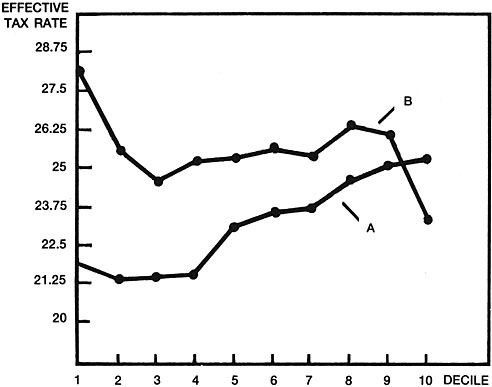
Discussion by economist Joel Slemrod noting that the most detailed study ever done on American tax burdens, by Joseph Pechman in 1984, indicated that whether those at the top or bottom end of the income scale pay a higher percentage of their incomes in total taxes depends on the assumption used of who bears the ultimate burden of corporate taxation:
CHART1 illustrates the progressivity of the overall U.S. tax system in 1985 (the latest year for which this information is available), according to two different assumptions about the shifting of taxes. Under assumption A the average tax rate generally increased with income, suggesting a generally progressive tax. Under assumption B the average tax rate actually is lowest for families in the highest income decile. The key difference between the two results is that B assumes that half of the corporation income tax is shifted to consumers, in the form of higher prices, while A assumes that all of it is borne by shareholders, who are generally high-income taxpayers. Chart 1 illustrates both the importance of the shifting assumptions and the fact that, even though the federal income tax by itself is progressive, its progressivity is overwhelmed by less progressive levies such as sales taxes and, to a lesser extent, the payroll tax.

http://www.econlib.org/library/Enc1/art/fig14.jpg
Chart 1. Effective Tax Rate by Income Decile, 1985

SOURCE: Graph from Stiglitz, p. 348, based on Pechman, 1985.


University of Michigan Business School Office of Tax Policy and Research
Center on Budget and Policy Priorities
Fiscal advocacy for moderate-to-lower incomes.
Citizens for Tax Justice
Tax advocacy group.
Critiques of Libertarianism
Mike Huben compiles critiques of libertarian anti-taxation arguments.
Economics 127 Public Finance: Taxation Syllabus
Dr. Deborah Garvey of Santa Clara University’s syllabus points to several useful resources.
Econ 315: Public Economics
University of Missouri.
Washington Post Tax Policy
Urban-Brookings Tax Policy Center
“Provides timely, accessible analysis and facts about tax policy to policymakers, journalists, citizens, and researchers.”
President's Advisory Panel on Federal Tax Reform
Joint Committee on Taxation
Taxing Thoughts

Debate Stream

1996

6/23
Cutting Taxes Could Also Cut Growth
William Gale of Brookings expounds on the risks of certain tax-cutting policy mixes.

1999

1/21
Information and Misinformation about Federal Tax Burdens
A Center on Budget and Policy Priorities brief rebutting Tax Foundation numbers on median family tax burdens.
2/24
Are Americans Really Overtaxed?
William Gale outlines issues of tax burdens.
March
The Case Against Tax Cuts
William Gale briefly surveys tax burdens in this Brookings Institute Policy Brief.

2000

8/20
Most Unkindest Cuts
Paul Krugman distills the difference between the two party’s income tax proposals and counters the Wall Street Journal’s recycling of the University of Michigan study.
8/23
Al Gore’s Class Warfare
Bruce Bartlett responds to Krugman (by citing the Michigan and Dallas Fed studies.)

2001

2/12
The Rich Get Richer
Edward Wolff, writing in the American Prospect , enumerates proposals to alleviate the effects of income and wealth inequality.
6/1
Tax Policy From 1990 to 2001[PDF]
A review by Eugene Steuerle of the Urban Institute.
6/11
Tax Burden Rising for the Rich and Not So Rich
Bruce Bartlett, writing for the Pete Dupont-founded National Center for Policy Analysis, responds in an assessment of the tax rates on the top 5%.

2002

4/10
Overall Federal Tax Burden on Most Families — Including Middle-Income Families — at Lowest Levels in More Than Two Decades: Income Taxes for Median Family of Four at Lowest Level in 44 Years
An update on middle-class tax burdens from the verbose Center on Budget and Policy Priorities.
9/19
Alternative Minimum Tax
Brad DeLong introduces a New York Times article outlining the effects of the Bush tax cut on the middle class.
10/31
Do Lower Taxes Mean Faster Economic Growth?
Jeff Madrick, writing in The New York Times, surveys the empirical evidence against long-run stimulative effects of tax cuts.
11/7
Whinging and Snivelling From a Democrat
Brad DeLong, writing in his Semi-Daily Journal, lays out a theoretical basis for efficacious Republican tax policy:
· ... Let me give you some marginal tax rates... a mother with two kids earning $24000: 68% (she loses the last of her food stamps, and her earned income tax credit phases out)... a doctor making $200,000: 36.4%... an executive making $1,000,000: 40%... Any decent supply-sider would say that the real place where marginal tax rates needed to be cut in 2001 was around the $25000 a year zone: the place where the phase out of the earned income credit makes marginal rates astronomical. We economist types were never able to interest Clinton and company in such a proposal--at a gut level, Clinton simply didn't get the importance of lower marginal rates so that people don't get hit in the nose by a 2 x 4 when they work more hours and the IRS snarfs most of it. Larry Lindsey is supposed to have led a charge to get a proposal to "deal with the EITC phaseout problem" into the 2001 tax bill, but he got absolutely nowhere. Bush, Cheney, and their personal staffs don't resonate with the problems of mothers of two making $12 an hour... mothers of two making $12 an hour don't give big to Republican presidential candidates, or show up at the $1000 a plate dinners that are what presidential candidates do day after day these days. So we got a tax cut that gives 40% of its notional dollars to those making more than $300,000 a year whose marginal tax rates are much lower than those of the mother of two earning $12 an hour. (Larry Lindsey keeps saying that they'll come back to it and fix it; but the word is that he's about to get "invited" to "spend more time with his family.")
12/8
If Tax History Is a Guide, the Poor Are in Trouble
Roger Altman surveys the Republican Party’s historical antipathy to tax relief for those with lower incomes, and notes that a Brookings study by Joseph Pechman in the 1980s indicated that the totality of the American tax system does not effectively change the state of income distribution.

2005

Toward Fundamental Tax Reform [PDF]
AEI publication including Joel Slemrod and others.
4/12
Guest Viewpoint: Some taxation principles, to get debate started
An Op-ed in the Register-Guard by University of Oregon economist Mark Thoma on distributive equity and its application in normative arguments about taxation.
5/5
What Should a Reconfigured Tax System Look Like?
Economist Hal Varian.
7/10
SPINNING THE MYTH....
Kevin Drum on the dearth of family farms paying the Estate tax.
8/15
A Flat Tax Recipe for Disaster
Mark Thoma, at his blog Economist's View, on the latest Steve Forbes column.
10/18
Tax Reform
Kash at the blog Angry Bear links to New York Times coverage of Bush's tax advisory commission and mulls over tax simplification.

2011

8/14
Stop Coddling the Super-Rich
Warren Buffett's classic New York Times op-ed:
Last year my federal tax bill — the income tax I paid, as well as payroll taxes paid by me and on my behalf — was $6,938,744. That sounds like a lot of money. But what I paid was only 17.4 percent of my taxable income — and that’s actually a lower percentage than was paid by any of the other 20 people in our office. Their tax burdens ranged from 33 percent to 41 percent and averaged 36 percent.

If you make money with money, as some of my super-rich friends do, your percentage may be a bit lower than mine. But if you earn money from a job, your percentage will surely exceed mine — most likely by a lot.

To understand why, you need to examine the sources of government revenue. Last year about 80 percent of these revenues came from personal income taxes and payroll taxes. The mega-rich pay income taxes at a rate of 15 percent on most of their earnings but pay practically nothing in payroll taxes. It’s a different story for the middle class: typically, they fall into the 15 percent and 25 percent income tax brackets, and then are hit with heavy payroll taxes to boot.
2012

1/19
Corporate Taxes And The .01 Percent
Paul Krugman on the implications on imputing the corporate tax burden to shareholders:
On the question of how profits taxation plays into tax burdens, the CBO has already done those calculations. In particular, it did a special version of its usual tax shares analysis that looked inside the top 0.01 percent, taking the data up through 2005 (pdf). According to this analysis, in 2005 the top .01 percent paid only 17 percent of income in income taxes — but they faced an overall federal tax rate of 31.5 percent, with almost all the difference being imputed corporate taxes.

But is this really where the right wants to go? I thought corporations were people — by which Romney meant not that they eat and sleep, but that they employ people, and by being nice to corporations we’re being nice to workers. If you say instead that corporate profits benefit only the stockholders — which is what you’re implicitly saying if you impute all profits taxes to the stockholders — so much for the warm and fuzzy feelings.
2014

5/5
Unequal to the Task 
In the National Review, Joshua Hendrickson of the University of Mississippi reviews Thomas Piketty's book Capital
Piketty’s policy solution is logically consistent with his concern regarding the growing importance of inheritance, but it is inadequate. A better conceptual framework for devising tax policy — and one that is consistent with the theoretical literature in this field — would be the following: Some people are born to wealthy parents, and others are born to poor parents. This is what is known as an “idiosyncratic risk.” The government might want a tax policy that insures individuals against this risk; this would tend to be a policy that has high taxes on inheritance. On the other hand, high taxes would discourage the accumulation of wealth. The government therefore must balance the desire to insure individuals against the lottery of birth with the desire to encourage the most productive members of society to be as productive as possible and, in the process, accumulate wealth.

The implications of this framework are at odds with the policy solutions that Piketty suggests. Specifically, while this framework suggests that the optimal tax on inheritance should be progressive, it also implies that the marginal tax rate should be negative. In other words, the optimal tax policy for inheritance is to subsidize inheritance and to reduce the size of the subsidy with the size of the inheritance. It is easy to understand the intuition behind this conclusion: Subsidizing inheritance prevents the deterrent effect of taxation, and the greater subsidization of inheritance for children of poor parents reduces the risks associated with birth.