Tuesday, June 14, 2005

Taxation Archive

2003 Tax Cut Survey


Online Resources

Discussion by economist Joel Slemrod noting that the most detailed study ever done on American tax burdens, by Joseph Pechman in 1984, indicated that whether those at the top or bottom end of the income scale pay a higher percentage of their incomes in total taxes depends on the assumption used of who bears the ultimate burden of corporate taxation:
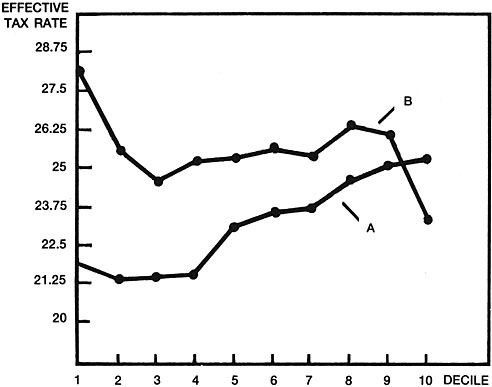
CHART1 illustrates the progressivity of the overall U.S. tax system in 1985 (the latest year for which this information is available), according to two different assumptions about the shifting of taxes. Under assumption A the average tax rate generally increased with income, suggesting a generally progressive tax. Under assumption B the average tax rate actually is lowest for families in the highest income decile. The key difference between the two results is that B assumes that half of the corporation income tax is shifted to consumers, in the form of higher prices, while A assumes that all of it is borne by shareholders, who are generally high-income taxpayers. Chart 1 illustrates both the importance of the shifting assumptions and the fact that, even though the federal income tax by itself is progressive, its progressivity is overwhelmed by less progressive levies such as sales taxes and, to a lesser extent, the payroll tax.
http://www.econlib.org/library/Enc1/art/fig14.jpg
Chart 1. Effective Tax Rate by Income Decile, 1985

SOURCE: Graph from Stiglitz, p. 348, based on Pechman, 1985.


University of Michigan Business School Office of Tax Policy and Research
Center on Budget and Policy Priorities
Fiscal advocacy for moderate-to-lower incomes.
Citizens for Tax Justice
Tax advocacy group.
Critiques of Libertarianism
Mike Huben compiles critiques of libertarian anti-taxation arguments.
Economics 127 Public Finance: Taxation Syllabus
Dr. Deborah Garvey of Santa Clara University’s syllabus points to several useful resources.
Econ 315: Public Economics
University of Missouri.
Washington Post Tax Policy
Urban-Brookings Tax Policy Center
“Provides timely, accessible analysis and facts about tax policy to policymakers, journalists, citizens, and researchers.”
President's Advisory Panel on Federal Tax Reform
Joint Committee on Taxation
Taxing Thoughts

Debate Stream

1996

6/23
Cutting Taxes Could Also Cut Growth
William Gale of Brookings expounds on the risks of certain tax-cutting policy mixes.

1999

1/21
Information and Misinformation about Federal Tax Burdens
A Center on Budget and Policy Priorities brief rebutting Tax Foundation numbers on median family tax burdens.
2/24
Are Americans Really Overtaxed?
William Gale outlines issues of tax burdens.
March
The Case Against Tax Cuts
William Gale briefly surveys tax burdens in this Brookings Institute Policy Brief.

2000

8/20
Most Unkindest Cuts
Paul Krugman distills the difference between the two party’s income tax proposals and counters the Wall Street Journal’s recycling of the University of Michigan study.
8/23
Al Gore’s Class Warfare
Bruce Bartlett responds to Krugman (by citing the Michigan and Dallas Fed studies.)

2001

2/12
The Rich Get Richer
Edward Wolff, writing in the American Prospect , enumerates proposals to alleviate the effects of income and wealth inequality.
6/1
Tax Policy From 1990 to 2001[PDF]
A review by Eugene Steuerle of the Urban Institute.
6/11
Tax Burden Rising for the Rich and Not So Rich
Bruce Bartlett, writing for the Pete Dupont-founded National Center for Policy Analysis, responds in an assessment of the tax rates on the top 5%.

2002

4/10
Overall Federal Tax Burden on Most Families — Including Middle-Income Families — at Lowest Levels in More Than Two Decades: Income Taxes for Median Family of Four at Lowest Level in 44 Years
An update on middle-class tax burdens from the verbose Center on Budget and Policy Priorities.
9/19
Alternative Minimum Tax
Brad DeLong introduces a New York Times article outlining the effects of the Bush tax cut on the middle class.
10/31
Do Lower Taxes Mean Faster Economic Growth?
Jeff Madrick, writing in The New York Times, surveys the empirical evidence against long-run stimulative effects of tax cuts.
11/7
Whinging and Snivelling From a Democrat
Brad DeLong, writing in his Semi-Daily Journal, lays out a theoretical basis for efficacious Republican tax policy:
· ... Let me give you some marginal tax rates... a mother with two kids earning $24000: 68% (she loses the last of her food stamps, and her earned income tax credit phases out)... a doctor making $200,000: 36.4%... an executive making $1,000,000: 40%... Any decent supply-sider would say that the real place where marginal tax rates needed to be cut in 2001 was around the $25000 a year zone: the place where the phase out of the earned income credit makes marginal rates astronomical. We economist types were never able to interest Clinton and company in such a proposal--at a gut level, Clinton simply didn't get the importance of lower marginal rates so that people don't get hit in the nose by a 2 x 4 when they work more hours and the IRS snarfs most of it. Larry Lindsey is supposed to have led a charge to get a proposal to "deal with the EITC phaseout problem" into the 2001 tax bill, but he got absolutely nowhere. Bush, Cheney, and their personal staffs don't resonate with the problems of mothers of two making $12 an hour... mothers of two making $12 an hour don't give big to Republican presidential candidates, or show up at the $1000 a plate dinners that are what presidential candidates do day after day these days. So we got a tax cut that gives 40% of its notional dollars to those making more than $300,000 a year whose marginal tax rates are much lower than those of the mother of two earning $12 an hour. (Larry Lindsey keeps saying that they'll come back to it and fix it; but the word is that he's about to get "invited" to "spend more time with his family.")
12/8
If Tax History Is a Guide, the Poor Are in Trouble
Roger Altman surveys the Republican Party’s historical antipathy to tax relief for those with lower incomes, and notes that a Brookings study by Joseph Pechman in the 1980s indicated that the totality of the American tax system does not effectively change the state of income distribution.

2005

Toward Fundamental Tax Reform [PDF]
AEI publication including Joel Slemrod and others.
4/12
Guest Viewpoint: Some taxation principles, to get debate started
An Op-ed in the Register-Guard by University of Oregon economist Mark Thoma on distributive equity and its application in normative arguments about taxation.
5/5
What Should a Reconfigured Tax System Look Like?
Economist Hal Varian.
7/10
SPINNING THE MYTH....
Kevin Drum on the dearth of family farms paying the Estate tax.
8/15
A Flat Tax Recipe for Disaster
Mark Thoma, at his blog Economist's View, on the latest Steve Forbes column.
10/18
Tax Reform
Kash at the blog Angry Bear links to New York Times coverage of Bush's tax advisory commission and mulls over tax simplification.

2011

8/14
Stop Coddling the Super-Rich
Warren Buffett's classic New York Times op-ed:
Last year my federal tax bill — the income tax I paid, as well as payroll taxes paid by me and on my behalf — was $6,938,744. That sounds like a lot of money. But what I paid was only 17.4 percent of my taxable income — and that’s actually a lower percentage than was paid by any of the other 20 people in our office. Their tax burdens ranged from 33 percent to 41 percent and averaged 36 percent.

If you make money with money, as some of my super-rich friends do, your percentage may be a bit lower than mine. But if you earn money from a job, your percentage will surely exceed mine — most likely by a lot.

To understand why, you need to examine the sources of government revenue. Last year about 80 percent of these revenues came from personal income taxes and payroll taxes. The mega-rich pay income taxes at a rate of 15 percent on most of their earnings but pay practically nothing in payroll taxes. It’s a different story for the middle class: typically, they fall into the 15 percent and 25 percent income tax brackets, and then are hit with heavy payroll taxes to boot.
2012

1/19
Corporate Taxes And The .01 Percent
Paul Krugman on the implications on imputing the corporate tax burden to shareholders:
On the question of how profits taxation plays into tax burdens, the CBO has already done those calculations. In particular, it did a special version of its usual tax shares analysis that looked inside the top 0.01 percent, taking the data up through 2005 (pdf). According to this analysis, in 2005 the top .01 percent paid only 17 percent of income in income taxes — but they faced an overall federal tax rate of 31.5 percent, with almost all the difference being imputed corporate taxes.

But is this really where the right wants to go? I thought corporations were people — by which Romney meant not that they eat and sleep, but that they employ people, and by being nice to corporations we’re being nice to workers. If you say instead that corporate profits benefit only the stockholders — which is what you’re implicitly saying if you impute all profits taxes to the stockholders — so much for the warm and fuzzy feelings.
2014

5/5
Unequal to the Task 
In the National Review, Joshua Hendrickson of the University of Mississippi reviews Thomas Piketty's book Capital
Piketty’s policy solution is logically consistent with his concern regarding the growing importance of inheritance, but it is inadequate. A better conceptual framework for devising tax policy — and one that is consistent with the theoretical literature in this field — would be the following: Some people are born to wealthy parents, and others are born to poor parents. This is what is known as an “idiosyncratic risk.” The government might want a tax policy that insures individuals against this risk; this would tend to be a policy that has high taxes on inheritance. On the other hand, high taxes would discourage the accumulation of wealth. The government therefore must balance the desire to insure individuals against the lottery of birth with the desire to encourage the most productive members of society to be as productive as possible and, in the process, accumulate wealth.

The implications of this framework are at odds with the policy solutions that Piketty suggests. Specifically, while this framework suggests that the optimal tax on inheritance should be progressive, it also implies that the marginal tax rate should be negative. In other words, the optimal tax policy for inheritance is to subsidize inheritance and to reduce the size of the subsidy with the size of the inheritance. It is easy to understand the intuition behind this conclusion: Subsidizing inheritance prevents the deterrent effect of taxation, and the greater subsidization of inheritance for children of poor parents reduces the risks associated with birth.

Tuesday, May 31, 2005

Not Fade Away

When FDR named Douglas MacArthur in private conversation as one of the two most dangerous men in America way back in 1932, the latter's actions earlier in the year in the attack on the Bonus Army in a manner exceeding the orders of President Hoover probably had something to do with it.

A couple of weekends ago I caught the end of a C-SPAN presentation by the authors of The Bonus Army: An American Epic. They described the Bonus Army's ultimate doom at the hands of the Roosevelt administration who stuck them in Florida tent city with no logistical hope of escape when a hurricane hit:
The events in Washington in the summer of 1932 involved men who would become three of the most famous American generals of the twentieth century, acting in roles largely forgotten today. On Douglas A. MacArthur, George S.Patton, and Dwight D. Eisenhower would fall the duty of obeying commander in chief Herbert Hoover, who ordered the expulsion of the Bonus Army from Washington. At the foot of Capitol Hill were tanks, bayonets, and tear gas. Two veterans were killed by a policeman who was murdered less than a month later. Soldiers put to the torch the sprawling main Bonus Army camp. The veterans and their families began a forced exodus.

Most accounts of the Bonus Army end with newsreel coverage of veterans marching off into obscurity. But this is not how it played out in real life. What lay ahead for many of the veterans were futile returns to New Deal Washington, dollar-a-day labor in remote federal work camps, and a hurricane unlike any ever recorded in the United States. Wind gusts estimated at two hundred miles an hour slammed into work camps in Florida’s upper Keys, turning granules of sand into tiny missiles that blasted flesh from human faces. The storm brought death to at least 259 veterans. The final indignity was mass cremation.

In many ways the legacy of the Bonus Army is still being felt. Harry Specter, who had been wounded in the Argonne, had too little money to leave Wichita, Kansas, and march to Washington. He also had a wife and four children to provide for. The youngest child was two-year-old Arlen, who as a U.S. senator from Pennsylvania said much later, “In a figurative sense I have been on my way to Washington ever since to collect my father’s bonus—to push the government to treat its citizens, the millions of hardworking Harry Specters, justly.”
Of course, MacArthur evidently got enough of his walk-on-water yayas out by wielding supreme executive power in Japan for several years to be content to "fade away" subsequent to being dismissed for insubordination to civilian authorities in the conduct of the Korean War.

What is less explainable is how the Bonus Army has faded away within American history.

Tuesday, May 03, 2005

Full Circle on Bankruptcy

On the brink of FDR's inauguration, straits were so desperate in Iowa as to provoke practices you won't find prescribed in any Bush bankruptcy bill:
The debt situation was becoming increasingly critical. In Iowa, the most heavily mortgaged state, nearly one-third of the value of farms was in thrall, mainly to banks and insurance companies. Sinking farm prices made it harder than ever to pay interest or taxes out of cash received for current production. With misfortune striking down the industrious equally with the idle and the incompetent, farmers grew increasingly determined not to surrender without a fight. They formed committees of action to resist tax sales and mortgage foreclosures -- unsmiling men, dressed in overalls or in corduroy, wearing old red or green sweaters, carrying clubs.

At Storm Lake, Iowa, farmers flourished a rope and threatened to hang a lawyer who was about to conduct a foreclosure. In Van Buren County, Iowa, Mrs. Otto Nau forced Sheriff Bostock off her farm at the point of a rifle. At Le Mars, five hundred men gathered in a sullen mob to watch the farm of John A. Johnson go on auction: when the agent for the New York Life Insurance company offered a sum less than the face value of the mortgage, people slapped and mauled him; a few shouted "Lynch him!" Outside of Pleasanton, Kansas, someone found the murdered body of a man who had just foreclosed on a five-hundred-acre farm. At Sidney, Nebraska, farm leaders threatened to march two hundred thousand debtors to the State Capitol at Lincoln and "tear it down" unless they got relief. At Malinta, Ohio, a noose hung ominously from Albert Roehl's barn to ward off outside bidders. In one bankruptcy proceeding after another, friends of the debtor, using unspoken intimidation to cut off other bids, bought back the property for a few cents and restored it to its owner.
[Arthur M. Schlesinger, Jr. The Age of Roosevelt:The Crisis of the Old Order, pp.459-460]

How many "thirds-of-value" is Congress "in thrall" mainly to banks and insurance companies today?

Wednesday, April 27, 2005

A New Hope

The Age of Roosevelt: The Crisis of the Old Order 1919-1933. Arthur M. Schlesinger, Jr. Houghton Mifflin Company, 1957. 558 pp. $11.95

The Crisis of the Old Order is the first volume of Arthur Schlesinger's Age of Roosevelt series. There are three extant volumes but Schlesinger, now 87, supposedly has been working on further volume[s] over the years/decades to cover World War II.

I bought my paperback copy new from Borders four years ago. In the meantime I’ve picked up a used copy of the third volume The Politics of Upheaval in pretty good condition at a used bookstore.

Now I need to get a copy of Volume II.

As everyone knows, The Crisis of the Old Order was made into a major science fiction blockbuster motion picture in 1977 starring Harrison Ford and Alec Guinn--- oops, wrong trilogy…

Since I've been spending some time in the last couple of months or so trying to get a handle on the Social Security issue it seemed appropriate to finally get around to reading these to get a feel for the milieu surrounding Social Security's birth. That will have to wait until later as this volume - which covers the era from 1919 to FDR's inaugural - does not provide it beyond one mention of New York State's social security initiative promulgated during his governorship.

Crisis is a combination straight-history/intellectual history/biography that actually begins at the "end" - the 1933 inaugural - before going - briefly - all the way back to the Theodore Roosevelt presidency, passing quickly over if not completely ignoring Taft and to spend more time on Wilson and the Great War. Over the first couple of hundred or so pages, Roosevelt himself often appears mainly as a side-commenter to the main events of the era not directly related to his rise. The campaign for the 1932 Democratic nomination is covered before Schlesinger finally doubles back and gives us about 70 pages of biography in time to cruise home with the summer and fall campaign and crisis of the surrounding circumstances amidst the tense and strange transition period. [So strained that it led to a constitutional amendment during Roosevelt's presidency truncating the interregnum from March to January.]

BEHOOVER MANEUVER

The emergence of Herbert Hoover as a household name for his Great War relief efforts gained him adherents on both sides of the aisle as a potential avatar/exemplar of progressive thought, the best of the modern era as signified by his engineering background as well as his managerial acumen. As he did not declare for either party prior to 1920, many Democrats, including Roosevelt, hoped he might eventually run for President on their side. He ended up as Secretary of Commerce under Harding, a tenure marked by bitter feuding with progressive Republican Secretary of Agriculture Henry C. Wallace over the fate of struggling farmers during the rural depression of the 1920s. Wallace wanted to transform the Department of Agriculture into an advocate for farmers within the federal government, Hoover considered Wallace’s embrace of protectionist legislation “fascism.” Another Secretary of Agriculture Henry Wallace would always blame his sciatica-racked father’s death in office on Hoover.

Schlesinger portrays Hoover as a tragic, obstinate, willful figure. By the end of that strained transition period following his 1932 defeat, he had gotten himself worked up to the point of believing that only his personal prescriptions could save America from the Depression and felt free to dictate terms of FDR's economic program to FDR. FDR merely termed his predecessor’s demands as "cheeky" and proceeded with the plans for the initial version of what came to be called the "New Deal."

Schlesinger's partisan approach is to basically make the case for FDR without having to making a case through argument. Example after example, anecdote after anecdote, of FDR's political skill with all of the deficiencies and inconsistencies of pleasing at least two interests at once on a particular issue showed the effectiveness of FDR's approach to political success such as his habit of saying "Yes! Yes!" to advocates of a point of view he may or may not agree with, Meaning “Yes! Yes! Keep talking” rather than “Yes! Yes! I agree!” Often leaving the latter impression whether either intentional or not. [Obviously reminiscent of another charming Presidential contender of 1990s vintage.]

LIBERAL SCHMIBERAL

The book includes a chapter on the state of American liberalism in this era and the influence of the ideas of the likes of Thorstein Veblen and John Dewey and the thrust of greater central economic planning in the wake of the success of Bernard Baruch's War Industrial Board [which Schlesinger gives short shrift to, by the way.] and the example of Russia.

Schlesinger later goes on to trace the struggles within the 1932 FDR campaign between the ["neo?"] Wilsonian "New Nationalism" outlook of embracing bigness in business and government as the inevitable outcome of modern efficiency and dealing with through greater economic and social planning vs. the Teddy Rooseveltian "New Freedom" strain of thought as exemplified by Felix Frankfurter which emphasized regulation and anti-trust.

Much of the economic thought emphasized the lack of purchasing power. Not enough of the national income was represented through wages and demand suffered [Some of that sound familiar too?]

For himself, Hoover changed his mind on what was the cause of the depression in the middle of his term. First, he thought it was domestic. Later, he thought it was international; the key was balancing the budget and shoring up the gold standard. Schlesinger implies that the reason for the change was to ward off the implications of the responsibility for lack of purchasing power on the American business community. According to Schlesinger,
In the end, Hoover, dragged despairingly along by events, decided that wherever he finally dug in constituted the limits of the permissible.
FDR, who went around campaigning in the countryside by introducing himself as a farmer, for his part had a pet notion that moving city-dwellers and some of their factories back to the countryside would give them more long-term economic independence by facilitating sideline business growing and selling food and other farm commodities. By 1932, Roosevelt, who had run for vice president on the 1920 James M. Cox ticket, had more national political experience than anyone else on his campaign team. As a result, all major campaign decisions eventually filtered up to him. He was literally his own campaign manager.

Once during the campaign FDR turned his head away from the loud voice of Huey Long emanating from his phone and mentioned to someone with him that Long was one of the two most dangerous men in America.

His companions respond: And the other?

“Douglas MacArthur.”

This was in 1932.

The moment is characteristic of a book which bristles with the choice quotes, anecdotes, references and observations that you’d expect from a guy who thinks he’s Arthur Schlesinger.

Sunday, April 24, 2005

Sisyphus as Social Democrat

Brad DeLong's Foreign Affairs review of a biography of John Kenneth Galbraith.
At the beginning of the twenty-first century, it has become clear who John Kenneth Galbraith really is: Sisyphus, constantly pushing the boulder of social-democratic enlightenment up the hill. But the hill, it turns out, is too steep, and Galbraith not mighty enough.
Ah. So if the next Galbraith won't cut it then who will be the next Keynes? Hopefully we won't meet circumstances requiring another one for reasons beyond making the West more politically safe for social democracy.

Saturday, April 23, 2005

Blogger bites?

I noticed last night the very end of the 2005 Social Security Meta-Narrative, which I added a couple of links to the other day, was missing. I don't think I lost more than half a sentence or so and it might have been my doing. Nonetheless, Blogger Anxiety has taken hold.

Just another day at The Initiative

The Hindustan Times highlights the perils of "e-waste" this Earth Day. While every day at the Earth-Based Initiative is Earth Day, "e-waste" here is obviously kept to a minimum...

Tuesday, April 05, 2005

Monopolies of Farce

An empty suit lightweight, freshman United States Senator John Cornyn,(R-Texas) stumbles, or rather tumbles, into the national spotlight and national infamy:
Finally, I don't know if there is a cause-and-effect connection, but we have seen some recent episodes of courthouse violence in this country -- certainly nothing new; we seem to have run through a spate of courthouse violence recently that has been on the news. I wonder whether there may be some connection between the perception in some quarters on some occasions where judges are making political decisions yet are unaccountable to the public, that it builds up and builds up to the point where some people engage in violence, certainly without any justification, but that is a concern I have that I wanted to share.
Does it lose something in the translation from the original McVeigh?

Monday, April 04, 2005

Josh Marshall's Start Page

Just added to links...

http://www.j-marshall.com/

Social Security Meta-Archive: February 2005

[Part of the Social Security Meta-Archive: 2005]

Social Security Meta-Archive: January 2005

2/1
Empty Promise: The Benefit to African American Men of Private
Accounts Under President Bush's Social Security Plan

Dean Baker. [Later summarized by Max Sawicky.]
Big and little black lies
A Daily Kos diary response to Luskin.
Many Unhappy Returns
Krugman on stocks and economic growth projections:

Schemes for Social Security privatization, like the one described in the 2004 Economic Report of the President, invariably assume that investing in stocks will yield a high annual rate of return, 6.5 or 7 percent after inflation, for at least the next 75 years. Without that assumption, these schemes can't deliver on their promises. Yet a rate of return that high is mathematically impossible unless the economy grows much faster than anyone is now expecting.

To explain why, I need to talk about stock returns. The yield on a stock comes from two components: cash that the company pays out in the form of dividends and stock buybacks, and capital gains. Right now, if dividends and buybacks were the whole story, the rate of return on stocks would be only 3 percent.

To get a 6.5 percent rate of return, you need capital gains: if dividends yield 3 percent, stock prices have to rise 3.5 percent per year after inflation. That doesn't sound too unreasonable if you're thinking only a few years ahead.

But privatizers need that high rate of return for 75 years or more. And the economic assumptions underlying most projections for Social Security make that impossible.

The Social Security projections that say the trust fund will be exhausted by 2042 assume that economic growth will slow as baby boomers leave the work force. The actuaries predict that economic growth, which averaged 3.4 percent per year over the last 75 years, will average only 1.9 percent over the next 75 years.

In the long run, profits grow at the same rate as the economy. So to get that 6.5 percent rate of return, stock prices would have to keep rising faster than profits, decade after decade.

The price-earnings ratio - the value of a company's stock, divided by its profits - is widely used to assess whether a stock is overvalued or undervalued. Historically, that ratio averaged about 14. Today it's about 20. Where would it have to go to yield a 6.5 percent rate of return?

I asked Dean Baker, of the Center for Economic and Policy Research, to help me out with that calculation (there are some technical details I won't get into). Here's what we found: by 2050, the price-earnings ratio would have to rise to about 70. By 2060, it would have to be more than 100.

In other words, to believe in a privatization-friendly rate of return, you have to believe that half a century from now, the average stock will be priced like technology stocks at the height of the Internet bubble - and that stock prices will nonetheless keep on rising.

Social Security privatizers usually defend their bullishness by saying that stock investors earned high returns in the past. But stocks are much more expensive than they used to be, relative to corporate profits; that means lower dividends per dollar of share value. And economic growth is expected to be slower.
Delong comment thread
Krugman's Unhappy Returns

Andrew Samwick:

The critical assumption in the Baker/Krugman example is that the dividend yield doesn't rise above a number like 3 percent, forcing the capital gains to cover the other 3.5 percent and be reinvested in the corporate sector. What if the payout ratio increased dramatically, so that capital gains accounted for only the same 1.9 percent return that matched the growth rate in profits and the economy as a whole? The inconsistency goes away, as the P/E ratio is stable…But is a high payout ratio (e.g., 50% larger than what Krugman is positing) so unrealistic?.......

The most realistic impetus to drive the payout ratio higher is that the size of the elderly cohort will increase fairly dramatically relative to the size of the working-age cohort. Over the 75-year period, the projection is for there to be 80 percent more beneficiaries relative to workers. As more and more of the equity is held by the elderly, there will be a greater demand for firms to pay dividends (or repurchase equity) so that the elderly can consume their accumulated wealth.

According to this theory, the reason the economy doesn't grow faster and P/E ratios don't explode despite the solid return to capital is that firms don't reinvest their earnings. They pay out their earnings to satisfy the consumption demands of the large cohort of elderly. That the payout ratio exceeds historical highs is supported by the projection that the relative size of that elderly cohort also exceeds historical highs. Before I hitch my wagon too firmly to this horse, I'd like to know more about the extent to which elderly have a preference for dividends as opposed to capital gains.

PRESENT AT THE CREATION
MaxSpeak coverage.
2/2
Festival of the Stock Returns!
DeLong on the aftermath of Krugman's column.
The Equity Premium Puzzle
More aftermath from the blog The Dead Parrot Society
White House Social Security Briefing
Starring Claire Buchan, White House Spokeswoman, and the infamous Senior Administration Official:
QUESTION: And am I right in assuming that in the way you describe this, because it's a wash in terms of the net effect on Social Security from the accounts by themselves, that it would be fair to describe this as having -- the personal accounts by themselves as having no effect whatsoever on the solvency issue?

SENIOR ADMINISTRATION OFFICIAL: On the second point, that's a fair inference.
Social Security dupery
The infamous Peter Ferrara.
2/3
Third Time Lucky
More aftermath/extended comment in the blog JustOneMinute.
theperfectworld
More aftermath with "pseudoerasmus" commenting on Samwick:

This is a clever argument I didn't think of earlier. The dividend payout ratio is currently about 30%. Krugman assumes a 60% payout ratio (which is also assumed by Jeremy Siegel in his optimistic projections for the stock market). But Samwick asks, why can't 90% be realistic? Such a high payout ratio means a much smaller rate of reinvestment of earnings by corporations, which would result in the very thing that the social security actuaries assume, i.e., the low growth rate in GDP. And the reason the payout ratio rises so much in the first place is that the retiree cohort, which is traditionally hungry for income-generating assets rather than growth assets, will be so huge.

Even if it turns out that the baby-boomer retirees are more willing than in the past to forego current income from stocks in favour of capital appreciation, I would have to concede that the a priori inconsistency of high stock return predictions and low growth projections no longer exists.

More:
A possible defeater to Samwick's argument is that a 90% payout ratio is inconsistent with a 1.9% growth in GDP, i.e., a 90% payout ratio might imply an even lower GDP growth rate than what the social security actuaries assume. Which is what Baker seems to be saying, but I have to look over his calculation to see whether that's right.
More:
In repeating Baker's 1999 calculations with updated projections for growth (1.9%) and a P/E ratio of 20, I reckon the highest dividend payout ratio that is consistent with a rate of corporate reinvestment that produces 1.9% GDP growth is 72% (i.e., reinvestment rate equal to 1.4% of stock prices, or 72% of the earnings yield of 5%, which is the reciprocal of the P/E ratio). That produces returns of about 5.5% (=3.6% dividend yield + 1.9% earnings growth). That's approximately what Baker said in his response to Samwick.

However, relatively small changes in a few factors could easily result in returns being around 6.5%, e.g., if the long-run P/E ratio were 17. There is also no particular reason to make the assumption, as Baker does, that growth in capital intensity (i.e., capital deepening) should account for slightly less than half of labour productivity growth. That may have been approximately true in the 1973-95 period, but it's not a long-run historical regularity. If capital deepening accounted for but a third of labour productivity growth (implying that technological improvements bear a slightly larger burden of contributing to the same rate of labour productivity growth than they did in 1973-95), then once again the return would be closer to 6.5%.

In light of the Samwick response, I don't think it's right any longer to say that high stock returns and low GDP growth projections are inconsistent, even if 5.5% is more probable than 6.5%.
Understanding The Bush Plan
A Matthew Yglesias critique.
Signs of Crisis Are Clear
Says Michael Tanner of the libertarian CATO Institute.
2/4
CEA Memo on Social Security
President Discusses Strengthening Social Security in Florida
White House transcript:
Q -- really understand how is it the new plan is going to fix that problem?

THE PRESIDENT: Because the -- all which is on the table begins to address the big cost drivers. For example, how benefits are calculate, for example, is on the table; whether or not benefits rise based upon wage increases or price increases. There's a series of parts of the formula that are being considered. And when you couple that, those different cost drivers, affecting those -- changing those with personal accounts, the idea is to get what has been promised more likely to be -- or closer delivered to what has been promised.

Does that make any sense to you? It's kind of muddled. Look, there's a series of things that cause the -- like, for example, benefits are calculated based upon the increase of wages, as opposed to the increase of prices. Some have suggested that we calculate -- the benefits will rise based upon inflation, as opposed to wage increases. There is a reform that would help solve the red if that were put into effect. In other words, how fast benefits grow, how fast the promised benefits grow, if those -- if that growth is affected, it will help on the red.

Okay, better? I'll keep working on it. (Laughter.)
The CEA Forecasts a *Big* Stock Market Crash
DeLong on the implications of what the CEA is and isn't saying.
Gambling With Your Retirement
Krugman on the Bush offer of retirement security as a loan.
Loan Bull
Donald Luskin responds.
Insecure Arguments
A "Special Report" from the American Spectator.
2/5
Talking Points Memo
Josh Marshall on defined benefits vs. defined contributions.
2/6
More Stock Returns
DeLong responds to Samwick:

Well, let's put GDP growth at 1.9% per year, earnings of companies in the index growing at GDP growth minus one percentage point, so we have 0.9% annual returns coming from there. If we are to have a total return of 6.5% per year, that leaves us 5.6% per year to come from dividends and stock buybacks. At current earnings yields of 3.8% per year, that means that corporate net investment would have to be negative: businesses would have to be spending almost 150% of their net earnings on cash flowing to shareholders, and running down their capital stocks. That can't be done--not if you want to maintain the profitability of the businesses. Failing to replace your capital that wears out and becomes obsolete is a really bad idea.

On The Baker Test
Matthew Yglesias on the implications of hypotheses on issues beyond Social Security.
Opportunity Costs and Notional Accounts
The Dead Parrot Society mines the implications of the 2001 Bush Commission's Model 2.
2/7
Who Would Like To Bet On Paul Krugman?
Tom MaGuire, writing at his blog Just One Minute, challenges Krugman on returns to capital.
Wall Street optimistic yet pragmatic on Social Security
Ron Scherer of the Christian Science Monitor on Wall Street's attitude toward Social Security reform.
2/8
Why Capital Gains Are Likely to Lag Economy-Wide Growth
Delong performs a "simple and embarrassingly crude calculation."
Spearing the Beast
Krugman on Social Security, the budget and the drive to privatize.
2/9
Truly Outrageous!
Jane Galt's take on Brit Hume's assertions on FDR's attitude toward private annuities supplementing Social Security triggers a long discussion on early Social Security history.
Private Accounts as a Loan from the Government to the Worker...
DeLong introduces today's Peter Orszag testimony.
The Minuteman Asks: Who Would Like To Bet On Paul Krugman?
DeLong counterbets MaGuire.
In Which I Claim The Dean Baker "No Economist's Left Behind" Cup
MaGuire reaches, dsquared comments:

What I mean here is that when Bill Miller reinvests his dividends, it doesn't necessarily have any effect on the GDP, because he is for the most part buying already existing equities on the secondary market. But "the market as a whole" can't reinvest by buying stocks on the secondary market; who would they buy them from?[1]. "The market as a whole" can only reinvest its dividends in newly issued stock; either IPOs or seasoned equity offerings.

But if you're buying stock in new companies or financing stock issuance by existing companies, then those companies are selling you shares because they want to do something with the money. Specifically, they want to buy more capital assets and use them to produce goods and services. Which means that GDP grows, hurray. This is why it's difficult to get a compound return of 6.5% without also assuming GDP growth higher than 1.9%.

And as I say, it has to be a compound return that we're interested in. The basic idea here is that you have to model the effect of reinvesting profits on the economy; to do otherwise (which I would argue you have to do in order to get the low growth/high returns outcome) is to commit something like the mirror image of James Glassman's fallacy; rather than double-counting dividends in the returns forecast, you're under-counting them in the GDP forecast.
Opinions on Shape of Earth Differ (Why Oh Why Can't We Have a Better Press Corps? Department)
Delong takes Jonathon Weisman of the Washington Post to task over his coverage of the economic growth/returns to capital debate.
AARP & Social Security: A Background Briefing[PDF]
The AARP makes its case in 17 pages.
The Days of Wine and Reagan
The Decembrist on the 1983 deal with further resources in comment.
Understanding Social Security
Elizabeth Anderson at Left2Right on the multitude of risks SS insures against.
2/10
Misunderstanding Social Security
CATO's Will Wilkinson, at his blog The Fly Bottle responds to Anderson.
America's Senior Moment
Paul Krugman reviews The Coming Generational Storm by Laurence J. Kotlikoff and Scott Burns while discussing the relative burden of Social Security, Medicare, and Medicaid:

Why Bush is right to privatize social security
"Dr Eamonn Butler" weighs in at the right-wing UK Adam Smith Institute blog.
Social Security Actuary scoring of Pozen Progressive Indexing Plan[PDF]
If there are no survivors, and the worker dies before such benefit entitlement, their estate would receive the balance in their IA at death minus an offset that would be paid to the Trust Funds to compensate for their earlier allocations of a portion of their payroll taxes to their IA.
We Move Towards The "Hummina Hummina" Moment
Tom MaGuire on Notional Offset accounts.
Now It Is Krugman Versus The Council Of Economic Advisors
Tom MaGuire on Krugman again.
The Editors on Social Security on National Review Online
Why Oh Why Can't We Have a Better Press Corps? (National Review Edition)
DeLong responds.
The Real Reason for Social Security Reform
Bruce Bartlett says Social Security isn't at risk but current income tax rates are.
2/11
Does Your Model Have HAIR?
Tom MaGuire continues.
The Privatization Tax
The Decembrist on Senate framing and Center on Budget and Policy Priorities calculating on the price of Privatization to many individual accounts.
The Amazing Disappearing Trust Fund
Washington Post ombudspersons let a liberal question from Dan Froomkin slip through:
Let's assume that it's not just a rhetorical device, or an attempt to confuse the issue. Let's assume that the president really believes that the Social Security trust fund doesn't exist. And let's just forget about the past two decades, during which workers overpaid more than a trillion dollars in payroll taxes. We'll write that off to an unfortunate misunderstanding.

But now take this one more step. Shouldn't Bush therefore call for an immediate cut in payroll taxes, effective immediately?

If Social Security is really pay-as-you-go, and any excess payroll tax revenue just goes into the general fund, why are American workers paying more than it costs to run the program? Why should they overpay Social Security payroll taxes for one more minute -- if in fact it doesn't do the Social Security system any good at all?

The latest numbers I've seen show that American workers this year will pay about $70 billion more in payroll taxes than will get paid out in benefits and administrative expenses. And it's a brutal tax. It's not the least bit progressive. In fact, because it's flat -- and capped at about $90,000 of annual income -- it's vastly tougher on the working poor than it is, say, on millionaires. Not to mention billionaires.

The only reason it's been socially acceptable to keep such a high, regressive tax on the books is that the system it was ostensibly keeping alive for the future returns money in a highly progressive way.

But if -- as of now -- that's not really the case, how can anyone defend it? A capped payroll tax is a pretty harsh way to raise $70 billion a year for the general fund.
2/12
Equity Returns and Economic Growth: Model-Building
PDF of DeLong's latest formulation:

  1. A substantial decline in the stock market in the near future to push dividend yields back up to the levels they need to be.
  2. Stagnant wages and a permanent jump in the profit share to push dividend yields up to the levels they need to be.
  3. A large jump in firm payouts, supported by the fact that accounting earnings are massively understated.
  4. A long-run trade surplus of 6% of GDP.
  5. Now none of these are impossible exactly. But only the first is at all likely.

Thinking Things Through
Matthew Yglesias counters Milton Friedman with a thought experiment, and echoes Dean Baker's noting of Samwick & Co.'s failure to think through the problem of growth vs. returns beyond "clever arguments".
2/13
POST HOC BULLSHIT
Kevin Drum riffs off of DeLong and Yglesias to summarize the response to Maguire's argument:
However, there's an aspect to this whole thing that bothers me, and Matt Yglesias devoted a considerable amount of philosophical brainpower to it yesterday. If I can summarize for the lay audience, it's this: the problem with Tom's argument is that it's just a random post-hoc effort to explain away a problem the privatizers hadn't thought of before (or had been able to ignore). In other words, it's part of the genus bullshit.

For the last 75 years, real stock market returns have closely followed GDP growth. GDP growth is projected to decline in the future, and common sense dictates that lower growth leads to lower corporate profits which in turn leads to lower stock market growth. When someone finally pointed this out, it meant that privatizers could no longer rely on their usual lazy (but credible sounding!) explanation that stock returns for the past 75 years had been around 7% and it was therefore reasonable to use those same returns going forward. They had to make up something new.

What resulted was a bizarre series of Rube Goldberg inventions designed to figure out something — anything — that might change in the next 75 years to make the low growth/high return scenario plausible. Maybe corporations will suddenly become far more profitable than they have been. Maybe they'll start paying out enormous dividends. Maybe overseas investment will skyrocket. In other words, toss every possible piece of mud on the wall you can think of and hope that something sticks. None of these things have to make sense, after all, they just have to sound plausible enough to create a cloud of FUD — fear, uncertainty, and doubt.

Frankly, the privatizers would be better off just telling the truth: stock market returns aren't going to be 7% in the future, but there's a pretty good case to be made that they'll be higher than the 3% you get from treasury bonds. Brad buys that argument, for example, and so does Dean Baker. Stock market returns of, say, 4% or 4.5% don't provide quite the sizzle of 7%, but they still make a perfectly reasonable story. Why not stick with it?

More Intellectual Garbage Pickup (Just How Bad Were We in Our Previous Lives to Deserve This? Department)
Delong vs. Weisman continued, Luskin thrown in.
2/14
The Infernal Machine of Imre Lakatos
DeLong follows up Yglesias and Drum & summarizes Maguire.
How to Talk to a Conservative About Social Security
From Think Progress.
2/15
Treasury experts split on Social Security plan
Jonathan Kaplan on the Treasury Department split between politicos and careerists in The Hill.
2/17
Alan Greenspan Explains it All
The liberal Center for American Progress harps on some of the implications of the latest Greenspan testimony.
2/18
Save and Save and Then Save Some More
Steven Landsburg on the need to formulate savings-encouraging policies.
2/19
Bush’s Mad Cap Idea
Larry Kudlow of National Review Online opposes any consideration of raising payroll tax wage caps.
2/22
Private-Account Concept Grew from Obscure Roots
Washington Post backstory coverage.
2/24
Guest Viewpoint: Social Security is about insurance, not savings
In the Register-Guard, economist Mark Thoma of the University of Oregon on Social Security's Job One.
2/25
Social Security and the Race Factor
A link to NPR reporting by Ari Shapiro.
2/28
And Another Excellent WSJ Article--This Time by Mark Whitehouse
DeLong:

The most bizarre thing--no, it isn't the most bizarre thing, it is just one of many bizarre things that make me question the good faith or the competence--no, make that the good faith and the competence--of those designing and arguing for the Bush private accounts plan--is the 3% + inflation offset required for those who fund their private accounts. This is likely to generate a substantial increase in elderly poverty when a bunch of people reach 65 and find that their private accounts have not been worth the Social Security benefit reductions they cost.
Social Security Meta-Archive: 2005

Friday, April 01, 2005

Social Security Meta-Archive: January 2005

[Part of the Social Security Meta-Archive: December 2005]

Social Security Meta-Archive: December 2004

1/1
Confusions about Social Security
Several pages from Krugman writing about Social Security in The Economist's Voice.
David Wessel Does His Social Security Grading
DeLong survey's the Wall Street Journal reporter's grading of the Bush administration and various Democratic players in the SS debate.
1/2
Talking Points Memo
Joshua Micah Marshall on the Bush Administration's hopes to use all of those FICA taxes built up since 1983 to finance tax cuts instead of Social Security.
Social Security Crisis in 2018? Ridiculous
Economist Brad Setser on why it's the Federal "General Fund" that has to pay up in 2018, not Social Security:

Unless the US treasury cannot make good on its promises -- something that truly would change international financial system -- social security does not face a day of reckoning in 2018. When a bond you own comes due, you have the right to redeem it -- or in the case of social security, at least to collect the interest on your bonds (remember that right now social security is both taking in $68 billion more from the payroll tax than it spends on benefits and is lending the $85 billion interest it recieves on its existing holdings of bonds back to the rest of the government ... in total, social security is providing over $153 billion in financing to the rest of the government)

Don't forget that the government -- the non social security part -- has expenditures well in excess of revenues RIGHT NOW. Dick Cheney apparently thinks cash flow deficits that have to be financed by issuing tons of debt don't matter, but cash flow deficits than can be financed by drawing on the interest from your stock of existing assets are a real problem ... interesting financial logic.

An aside: Anyone writing about the social security ought to read both the Trustees and the CBO report. I do have one quibble with the CBO though: its graphics subtly suggest that social security is in much worse shape than it really is. The main graphs focus on payroll taxes v. expenditures, and the graph has been chopped off to magnify the apparent size of the shortfall (the graph starts at 3% of GDP, not 0%). The CBO also buries the key graph showing when the Trust Fund runs out -- i.e. when the gap between payroll taxes and promised benefits can no longer be financed social security's assets. Looking just at the graphs, it is not obvious that the CBO thinks the system is in better shape than the Trustees ...

In 2018, social security won't be able to lend its surplus to the rest of the government, and the rest of the government will have to adjust. That is a problem if you don't like the income tax, because the rest of the government is financed largely by the income tax. Income taxes have to rise, or non-social security spending will have to fall. But so long as the US government is not planning on defaulting, it is not a problem for social security. The payroll tax does not need to increase in 2018, retirement benefits do not need to be cut, there is no problem, let alone a day of reckoning. The Treasury just has to start paying interest on all the bonds social security has bought ...

I think part of the problem the press has is that it seems like the retirement of the baby boom should cause problems for social security. The number of retirees will grow, the numbers of workers per retirees will shrink, and social security benefits will increase from around 4.4% of GDP to about 6% of GDP. How could a constant payroll tax be able to finance the retirement of the baby boom? On the surface, it does not make sense.

The funny thing is that US government was actually responsible in the 1980s, and planned ahead for the impact of the baby boom on social security. The retirement age was increased (a de facto benefit cut), and payroll taxes were raised. Right now the payroll tax takes in more than is needed to pay for current benefits -- revenues are around 5% of GDP and expenditures are around 4.4% of GDP -- and the surplus is lent to the rest of the government. It is a loan, not a grant. The government has to pay it back.

Rather than debating the "problem" created when social security starts to redeem its bonds, we should be debating how to fix our real problem -- the fiscal deficit. Social security now takes in more than it spends. The rest of the government now spends way more than it takes in. On realistic assumptions, it will run a 3.5% of GDP deficit from now til eternity unless something changes -- and even bigger deficits from now til 2014 if you took out the social security surplus.

These ongoing fiscal deficits are the real financial problem facing the US -– not the projected gap after 2042 (or 2055) of 1.5% of GDP or so between payroll taxes and trust fund assets and social security benefits that underlies concern about social security's long-term solvency. I’ll put it differently: unless something changes, the rest of the government will go broke long before social security has any problem paying all its projected benefits.
1/3
White House Social Security Memo
By Karl Rove deputy Peter Wehner:

From: Wehner, Peter H. [mailto:Peter_H._Wehner@who.eop.gov]
Sent: Monday, January 03, 2005 2:57 PM
Subject: Some Thoughts on Social Security
I wanted to provide to you our latest thinking (not for attribution) on Social Security reform.

I don't need to tell you that this will be one of the most important conservative undertakings of modern times. If we succeed in reforming Social Security, it will rank as one of the most significant conservative governing achievements ever. The scope and scale of this endeavor are hard to overestimate.

Let me tell you first what our plans are in terms of sequencing and political strategy. We will focus on Social Security immediately in this new year. Our strategy will probably include speeches early this month to establish an important premise: the current system is heading for an iceberg. The notion that younger workers will receive anything like the benefits they have been promised is fiction, unless significant reforms are undertaken. We need to establish in the public mind a key fiscal fact: right now we are on an unsustainable course. That reality needs to be seared into the public consciousness; it is the pre-condition to authentic reform.

Given that, our aim is to introduce market reforms in Social Security and make the system permanently solvent and sustainable.

We intend to pursue the first goal by using our will and energy toward the creation of Personal Retirement Accounts. As you know, our advocacy for personal accounts is tied to our commitment to an Ownership Society -- one in which more people will own their health care plans and have the confidence of owning a piece of their retirement. Our goal is to provide a path to grater opportunity, more freedom, and more control for individuals over their own lives. That is what the personal account debate is fundamentally about -- and it is clearly the crucial new conservative idea in the history of the Social Security debate.

Second, we're going to take a very close look at changing the way benefits are calculated. As you probably know, under current law benefits are calculated by a "wage index" -- but because wages grow faster than inflation, so do Social Security benefits. If we don't address this aspect of the current system, we'll face serious economic risks.

It's worth noting that wage indexation was not part of the original design of Social Security. The current method of wage indexation was created in 1977, under (you guessed it) the Carter Administration. Wage indexation makes it impossible to "grow our way" out of the Social Security problem. If the economy grows faster and wages rise, this produces more tax revenue. But the faster wage growth also means that we owe more in Social Security benefits. This has produced a never-ending cycle of higher tax burdens, even during periods of robust economic growth. It is the classic case of the dog chasing his tail around the tree; he can run faster and faster, and never make any progress.

You may know that there is a small number of conservatives who prefer to push only for investment accounts and make no effort to adjust benefits -- therefore making no effort to address this fundamental structural problem. In my judgment, that's a bad idea. We simply cannot solve the Social Security problem with Personal Retirement Accounts alone. If the goal is permanent solvency and sustainability -- as we believe it should be --then Personal Retirements Accounts, for all their virtues, are insufficient to that task. And playing "kick the can" is simply not the credo of this President. He wants to do what needs to be done for genuine repair of Social Security.

If we duck our duty, it can have serious short-term economic consequences. Here's why. If we borrow $1-2 trillion to cover transition costs for personal savings accounts and make no changes to wage indexing, we will have borrowed trillions and will still confront more than $10 trillion in unfunded liabilities. This could easily cause an economic chain-reaction: the markets go south, interest rates go up, and the economy stalls out. To ignore the structural fiscal issues -- to wholly ignore the matter of the current system's benefit formula -- would be irresponsible.

Here's a startling fact: under current law, an average retiree in 2050 would be scheduled to receive close to 40 percent more (in real terms) in benefits than an average retiree today -- and yet there are no mechanisms in place to produce the revenue to pay out those benefits. No one on this planet can tell you why a 25-year-old person today is entitled to a 40 percent increase in Social Security benefits (in real terms) compared to what a person retiring today receives.

To meet those benefit levels, one option would be to raise the age at which people receive benefits. If we followed the formula used when Social Security was first created -- make the age at which you receive Social Security benefits above the average age of mortality -- we'd be looking at raising the benefit age to around 80. That ain't gonna happen.

Another way to meet those benefit levels is through the traditional Democrat/liberal way: higher taxation. According to the latest report of the Social Security Trustees, the current system's benefit formula would require some $10 trillion in tax increases over the long term. We'd therefore need to raise the payroll tax almost 20 percent simply to provide wage-indexed benefit levels to those born this year.

This will all sound familiar. In the past, the way Congress usually addressed the built-in funding problem was by raising payroll taxes (from 2 percent in 1937 to 12.4 percent today). In fact, Congress has raised Social Security taxes more than 30 times -- but it has never addressed the underlying problem. Avoiding the core issue by raising taxes is not the modus operandi of this President.

The other key point, as you know, is that personal accounts, through the miracle of compound interest, will provide workers with higher retirement benefits than they are currently receiving from Social Security.

At the end of the day, we want to promote both an ownership society and advance the idea of limited government. It seems to me our plan will do so; the plan of some others won't.

Let me add one other important point: we consider our Social Security reform not simply an economic challenge, but a moral goal and a moral good. We have a responsibility to fulfill the promise of Social Security, not undermine it. And we have a duty to ensure that we do not create an inter-generational conflict -- which is precisely what will happen if the Social Security system is not reformed. We need to retain strong ties between the generations, which is of course a deeply conservative belief.

The debate about Social Security is going to be a monumental clash of ideas -- and it's important for the conservative movement that we win both the battle of ideas and the legislation that will give those ideas life. The Democrat Party leadership, the AARP, and many others will go after Social Security reform hammer and tongs. See today's silly New York Times editorial (its only one for the day) as one example. But Democrats and liberals are in a precarious position; they are attempting to block reform to a system that almost every serious-minded person concedes needs it. They are in a position of arguing against modernizing a system created almost four generations ago. Increasingly the Democrat Party is the party of obstruction and opposition. It is the Party of the Past.

For the first time in six decades, the Social Security battle is one we can win -- and in doing so, we can help transform the political and philosophical landscape of the country. We have it within our grasp to move away from dependency on government and toward giving greater power and responsibility to individuals.

There are of course other important issues dealing with Social Security; for now, though, I've covered quite enough ground. I wanted to let you know where things stand. If you have any questions, or if we can send you anything to clarify our plans and respond to critics, just let me know. The President remains flexible on tactics -- and rock-solid on the principles. But there's nothing new there.

In one of his last public acts of an extraordinary public life, the late Democratic Senator from New York, Daniel Patrick Moynihan, co-chaired the President's Commission to Strengthen Social Security. In the introduction of its report, Senator Moynihan (along with Richard Parsons, his co-chair) wrote, "the time to include personal accounts in such action [reforming Social Security] has, indeed, arrived. The details of such accounts are negotiable, but their need is clear.... Carpe diem!"

And so we shall.
1/4
Security Flaws
Paul Starr of the American Prospect on the threat to national security presented by owing the cost of Social Security privatization to China.
Stopping the Bum's Rush
Krugman. Did Bush say "imminent"?
The Alternative Social Security Plan Democrats Need To Push As Part Of Their Second Term Agenda
The Diamond-Orszag plan offered as a political option for Democrats by the blog The Left Coaster.
A Tale Of 2 Systems
David Brooks compares America to Europe in facing changing demographics of aging.
High-Fiber Monopoly Diet
Matthew Yglesias responds:

Someone should tell Brooks what the "dependency ratio" actually is. Or that even if we don't change Social Security at all, its cost as a share of GDP will max out at a level far lower than Germany's current rate of public pension outlays. Or that while Europe is aging faster than America, the European model is, in some ways, better-suited to deal with the transition because they have a less costly health care sector. Or that his deployment of the phrase "either way" in paragraph nine indicates that he doesn't understand Edward Prescott's argument at all.

1/5
The Social Security Party Line: Talking Points
Brad DeLong lays down the party line.
1/6
The mask comes off the Social Insecurity plan
Blogger Mark Kleiman of UCLA:

There's a case for worrying that rising OASDI tax rates will become a significant work disincentive, especially if benefit levels are only weakly correlated with taxes paid.

And there's a case for worrying that the existence of Social Security as a relatively generous indexed annunity may be contributing to low household savings rates, and thus both to low national savings rates and to the scandalous maldistribution of wealth that has the typical American dying with not much more than he needs to bury him.

For a description of these problems and a sketch of possible solutions from someone who wants to fix the program rather than wrecking it, see James Tobin's Cowles Commission discussion paper from 1987.)

Now I'm more worried about work disincentives at the bottom of the income distribution, where the current Social Security system acts as an implicit subsidy, than at the top, and I'm far from convinced that private accounts are necessary, or even the best way, to deal with the problems of undersaving and inadequate wealth accumulation.

Still, I acknolwedge that the incentive effects of Social Security are worth worrying about, and that a properly-designed private account scheme might be able to fix them.

A properly-designed system, as my friend David Boyum points out, would have private accounts but not free choice of investment vehicles, and it would be progressive: the annual contribution to the private account would be a fixed sum, not a fixed percentage of earnings. And the payout from those accounts would be in the form of indexed annuities, with individuals having the option to reinvest a portion of what would otherwise be the payout in any given year but not to draw the account down faster than the annuity rate.

And, of course, the transition would be financed with some combination of taxation and spending cuts, not by floating another couple of trillion dollars' worth of bonds; otherwise the change does nothing for the national-savings problem.

But then Boyum asks the hard question: given that there exists a private-account system superior to the current system, should Democrats say that they're for it instead of rejecting private accounts altogether? If we had a rhetorically masterful leadership cadre, effective control of the communications channels, and a set of opponents constrained by intellectual honesty, or at least ordinary honesty, in their debating approach, there might be a good case for proposing a serious alternative.

The route to real pensions reform
Robert Pozen advocates "progressive indexing" in The Economist.
1/7
The Social Security Debate Once Again
DeLong links to separate Matthew Yglesias discussions of the level of retirement security provision and savings subsidies respectively.
1/9
Select Social Security Biblio
Many links from the blog Explananda.
1/10
Readers Challenge Wisdom of Using TSP as Model for Social Security Accounts
Stephen Barr of the Washington Post.
Why is Re-Indexing So Hard to Understand?
"Adam O'Neill" of the blog The Lowest Deep:

Under the Washington Post's misconception of the re-indexing plan, benefits fall because an individuals earnings are scaled up by the CPI instead of wage growth. But since people's wages grow, er, at the rate of wage growth, a person retiring in 2009 loses about the same fraction of currently promised benefits as someone retiring in 2039 or 2069 or 2099. Instead of everyone getting 42 percent of pre-retirement wages, everyone gets, say, 39 percent.

But re-indexing the "bend points" (which were set in 1979) results in cuts that grow geometrically over time. Each year, each new wave of retirees gets a deeper cut than the year before. Look at the CBO's numbers from table 3 (from their analysis of plan 2); every year replacement rates fall further:

(Year of birth, replacement rate)
1940- 42.8
1950- 39.9
1960- 34.8
1970- 30.9
1980- 27.4
1990- 24.6
2000- 21.7
If you keep extending the series, replacement rates continue right on down, asymptotically, towards zero.
Talking Points Memo
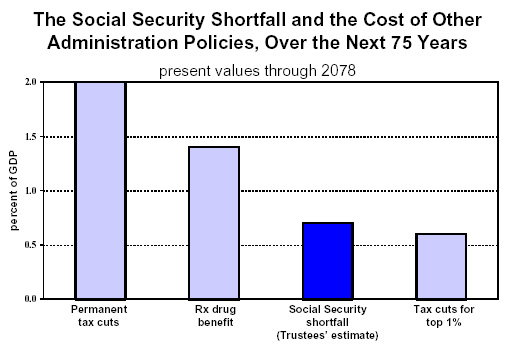
Josh Marshall links to a Center on Budget and Policy Priorities summary demonstrating that Social Security shortfalls are dwarfed by Bush's other fiscal initiatives:


Figure 1

1/11
A Bloody Mess
Norma Cohen, in The American Prospect, on the UK experience.
The Iceberg Cometh
Krugman on the SS "Iceberg" and what changing direction does or doesn't do fiscally.
Bush’s Numbers Racket
Dean Baker debunks Bush’s Big Sell.
Risk, Risk, Risk
Jim Geraghty of National Review Online attacks what he sees as the AARP's aversion to risk.
The C-Word: Say It
NRO's Donald Luskin, best-known as the "Stupidest Man Alive" lives up(?) to the rep:
The opponents of reform claim that the Social Security crisis is, in fact, a crisis of general public finance — not one of the Social Security system itself. They see Social Security as an entity separate from the federal government, and maintain that its own dedicated stream of tax revenues and trust-fund assets will keep it going for more than a third of a century.

That’s a fair point of view, as far as it goes. At the same time, it is dangerously myopic to treat Social Security in isolation from the overall finances of government. That would be like finding nothing troubling about a factory that dumps pollutants into a river. That may be no problem for the factory itself, but it can be a major problem for everyone downriver. And when it comes to Social Security, we’re all downriver.
Alas, when it comes to The Stupidest Man Alive, we're all down-bandwidth.

It's not Social Security that's "dumping the pollutants." It's the General Fund.

LENINIST-OLIGARCH EXPROPRIATIONIST WATCH
Max Sawicky surveys not-as-stupid-as-Luskin right-wing webbed commentary, focusing on NRO's The Corner.
1/12
Social Security: Crisis? What crisis?
CNN coverage.
1/13
Reforming Social Security
Brookings Briefing with multimedia including William Gale, Peter Orszag, and Robert Pozen.
1/14
The British Evasion
More from Krugman on UK pension schemes.
Social Security and the New Fiscal Policy
Excellent encapsulation of the privatization issue amidst discussion of Bush's profligate fiscal proclivities by Princeton economist Alan Blinder.
“Save Social Security First”?
Byron York says Social Security needs to be saved because Bill Clinton once said so.
1/15
The No. 1 Moral Issue Is--Abortion? No, Social Security
Jonathan Rauch on the moral appeal to conservatism of downsizing the socialization of risk of retirement security.
1/16
A Question of Numbers
Roger Lowenstein's New York Times Magazine article.
1/17
NPR Talk of the Nation: The Future of Social Security
Eugene Steurle, Dean Baker and Stephen Moore guest-star. [Not in THX.]
1/18
Thoughts on Social Security Reform [PDF]
Goldman Sachs analysis.
Stocks' Payoff Myth
Newsweek's Allan Sloan.
U.S. Births, Immigration May Ease Pressures on Social Security
Bloomberg article.
That Magic Moment
Krugman on selling Social Security on the Iraq Model.
Social Security Trust Fund is built on trillion-dollar IOUs
Larry Eichel of the Philadelphia Inquirer.
1/19
Yes, There Is No [Social Security] Crisis, But...
Brad DeLong:

Yes, there is no Social Security crisis. And, yes, whatever Bush proposal makes its way out of the administration must be opposed root and branch--Andrew Samwick and Kent Smetters could design a Social Security privatization scheme that would be an improvement over our present system, but they're not in control.

But there is a long-run Social Security problem--and a reasonable probability that there will be a big long-run Social Security problem--even though it ranks fourth on our list of fiscal problems. And there is a long-run health spending crisis. And there is a short-run deficit crisis. And there is a medium-run where-are-the-resources-to-pay-back-Social-Security crisis.

There is a fiscal crisis--there are lots of fiscal crises, some of them self-generated by the Bush administration. It's just that the fiscal crisis is not a Social Security crisis:

1/20
Newt Gingrich Denies That We Face a Social Security Crisis
Commentary on DeLong's blog in response to Bloomberg coverage.
1/21
The Free Lunch Bunch
Krugman on the politics of privatization.
John Berry Is Not Happy with George W. Bush
Brad DeLong links to a Bloomberg critique of Bush’s Big Sell.
And Paul Krugman Is Not Happy This Morning Either
DeLong mulls over the Bush approach to private accounts.
1/23
ADD TO SAVINGS
Laura D'Andrea Tyson advocates add-on private accounts in a "Social Security Plus" model.
1/25
John Kay Is Shrill!
The Ancient and Hermetic Order of the Shrill links to a Financial Times column on the Bush administration's fiscal brinksmanship when it comes to financing privatization.
Before And After
Angry Bear on Donald Luskin before and after the fact-check.
1/26
David Wessel Talks to the Wise Ned Gramlich About Social Security
Brad DeLong links to a Wall Street Journal interview.
PACK OF LIES
Max Sawicky on Rick Santorum's powerpoint Social Security presentation.
1/27
Social Security Privatization in Chile
DeLong links to a New York Times article.
Pinochet’s private pensions
...While John Quiggen comments at the blog Crooked Timber.
Social Security crisis? Not if wealthy pay their way
Kevin Drum, writing in the Christian Science Monitor, sees the 1983 reform as a grand bargain between the the FICA-tax paying middle class and the income-tax paying wealthy.
Privatizing Social Security: 'Me' Over 'We'
Benjamin R. Barber on approaching SS as a consumer vs. as a citizen.
Take the Plus
Arnold Kling of Tech Central Station is willing to compromise on Gene Sperling's "Social Security Plus."
1/28
Would Social Security Reform Increase Saving?
Richard Berner of Morgan Stanley
Little Black Lies.
Krugman on Bush racial mendacity.
Krugman On Social Security - Off To The Races
Tom Maguire at JustOneMinute responds, triggering extended debate.
Social Security And Distribution
Matthew Yglesias.
1/30
Outlines of a Social Security Deal?
DeLong.
1/31
Big Black Lies
Donald Luskin:

Look up the word “vile” in the dictionary and you will find an appropriate description of Paul Krugman’s New York Times column from last Friday.
Let the Looting Begin
The Mises Economics Blog decries compromising with those who actually want to pay for Social Security reform.
Don't use FDR to undermine Social Security
James Roosevelt, Jr.

Social Security Meta-Archive: February 2005

Social Security Meta-Archive: 2005

Thursday, March 17, 2005

Texas Death Penalty Archive

[Part of the Death Penalty Survey]

Online Resources

PDM - Texas
Belgium’s Amnesty International’s chapter’s Texas Death Penalty website.

Texas Coalition to Abolish the Death Penalty

Texans for Public Justice

Debate Chronology/Meta-Narrative

1998

3/1
The Death Penalty in Texas: Lethal Injustice
An Amnesty International report on the Texas Death Penalty.

2000

3/3
The Death Penalty Is Fair and Effective in Texas
Morgan Reynolds of the right-wing NCPA.
5/11
The hanging governor
Salon magazine covers the controversial execution of Gary Graham.
6/11
STATE OF EXECUTION: THE DEATH PENALTY IN TEXAS
Classic Chicago Tribune coverage.
8/28
Texas incarceration rate leads nation; crime rate lags behind other states
Another report on Texas’ lagging crime statistics
9/20
Don't Mess with Texas on Crime
Morgan Reynolds at NCPA.
10/1
Texas Tough?
"An Analysis of Incarceration and Crime Trends in The Lone Star State authored by Vincent Schiraldi and Jason Ziedenberg" from Justice Policy Institute.

Friday, March 11, 2005

Death Penalty Archive

Texas Death Penalty Survey

Online Resources

Abolish List FAQ
Archives of Abolish - The Mailing List For People Working to Abolish the Death PenaltyAbolish List FAQ
Amnesty International - The Death Penalty
The Liebman Report: "A Broken System:Error Rates in Capital Cases, 1973-1995"
Paul G. Cassell - Drafts of Working Papers and Articles
Campaign to Abolish the Death Penalty
Not to be confused with Campaign to End the Death Penalty.
Campaign to End the Death Penalty
Not to be confused with Campaign to Abolish the Death Penalty.
Capital Punishment and the Catholic Church
Clark County Prosecutor
Constitution Project
Critique of DPIC list
Death Penalty
Salon Magazine’s index of Death Penalty articles.
Death Penalty Debate
Death Penalty Issues
From truthinjustice.org
Deterrence and the Death Penalty:The Views of the Experts
Michael L. Radelet and Ronald L. Akers
DPIC
Federal Death Penalty Biased Against Whites
Focus on the Death Penalty
The Justice Project
Looking at the Death Penalty
Professor David’s death penalty resources.
Rick Halperin's DEATH PENALTY NEWS
Religion and the Death Penalty
Southern Center for Human Rights
Stephen Bright’s defendant advocacy organization.
Spotlight on the Death Penalty
A libertarian anti-Death Penalty site.
Wesley Lowe's Pro Death Penalty Webpage
What Politicians Don't Say About the High Costs of the Death Penalty
Richard C. Dieter of the Death Penalty Information Center on the Death Penalty’s impact on public finance.
Yahoo! Full Coverage US Death Penalty

Debate Chronology /Meta-Narrative


1988

10/13
The Second Bush-Dukakis Presidential Debate
SHAW: On behalf of the Commission on Presidential Debates, I am pleased to welcome you to the second presidential debate. I am Bernard Shaw of CNN, Cable News Network. My colleagues on the panel are Ann Compton of ABC NEWS; Margaret Warner of Newsweek magazine; and Andrea Mitchell of NBC NEWS. The candidates are Vice President George Bush, the Republican nominee; and Governor Michael Dukakis, the Democratic nominee. (Applause)

SHAW: For the next 90 minutes we will be questioning the candidates following a format designed and agreed to by representatives of the two campaigns. However, there are no restrictions on the questions that my colleagues and I can ask this evening, and the candidates have no prior knowledge of our questions. By agreement between the candidates, the first question goes to Gov. Dukakis. You have two minutes to respond. Governor, if Kitty Dukakis were raped and murdered, would you favor an irrevocable death penalty for the killer?

DUKAKIS: No, I don't, Bernard. And I think you know that I've opposed the death penalty during all of my life. I don't see any evidence that it's a deterrent, and I think there are better and more effective ways to deal with violent crime. We've done so in my own state. And it's one of the reasons why we have had the biggest drop in crime of any industrial state in America; why we have the lowest murder rate of any industrial state in America. But we have work to do in this nation. We have work to do to fight a real war, not a phony war, against drugs. And that's something I want to lead, something we haven't had over the course of the past many years, even though the Vice President has been at least allegedly in charge of that war. We have much to do to step up that war, to double the number of drug enforcement agents, to fight both here and abroad, to work with our neighbors in this hemisphere. And I want to call a hemispheric summit just as soon after the 20th of January as possible to fight that war. But we also have to deal with drug education prevention here at home. And that's one of the things that I hope I can lead personally as the President of the United States. We've had great success in my own state. And we've reached out to young people and their families and been able to help them by beginning drug education and prevention in the early elementary grades. So we can fight this war, and we can win this war. And we can do so in a way that marshals our forces, that provides real support for state and local law enforcement officers who have not been getting that support, and do it in a way which will bring down violence in this nation, will help our youngsters to stay away from drugs, will stop this avalanche of drugs that's pouring into the country, and will make it possible for our kids and our families to grow up in safe and secure and decent neighborhoods.

SHAW: Mr. Vice President, your one-minute rebuttal.

BUSH: Well, a lot of what this campaign is about, it seems to me Bernie, goes to the question of values. And here I do have, on this particular question, a big difference with my opponent. You see, I do believe that some crimes are so heinous, so brutal, so outrageous, and I'd say particularly those that result in the death of a police officer, for those real brutal crimes, I do believe in the death penalty, and I think it is a deterrent, and I believe we need it. And I'm glad that the Congress moved on this drug bill and have finally called for that related to these narcotics drug kingpins. And so we just have an honest difference of opinion: I support it and he doesn't.
1997

8/4
Danger of Executing the Innocent On the Rise
David Revola writes in the National Law Journal.
10/1
DEATH PENALTY AND SENTENCING INFORMATION
Dudley Sharp of prodeathpenalty.com.
11/4
New Fervor For Death Penalty
Christian Science Monitor coverage of Death Penalty resurgence.

1998

April
What do Murderers Deserve?
David Gelernter in Commentary.

2000

5/18
Death by misadventure: the death penalty in America
Kristen Edwards on the Death Penalty.
6/12
Dartmouth Chance News: Liebman v. Cassell
8/28
Paul Cassell and the Goblet of Fire
Edward Cohn profiles death penalty advocate Paul Cassell in The American Prospect.

2002

8/7
The New Abolitionism
Roger Parloff on the death penalty.

2005

A Cognitive Scientist Looks At Daubert
George Lakoff:

Politically, trial lawyers tend to be liberals; the wealthy ones tend to use their wealth to support liberal causes. Since the highest moral imperative for conservatives is to support and defend Strict Father morality itself, trial lawyers doing tort law are anathema to conservatives on the following grounds: the cases that trial lawyers win tend to support a liberal world view, the Public Interest Perspective, while conservatives tend to hold the Corporate Interest Perspective; and trial lawyers contribute money that they earn through verdicts they win to liberal causes and to the defeat of conservative causes. Daubert thus has a direct political role: it supports a conservative worldview over a liberal one, and it takes a lot of money out of liberal coffers and keeps it in conservative coffers.

Technically, Daubert ought to apply beyond tort law to scientific and other experts in criminal cases. If it did, defendants in criminal cases (some facing the death penalty) could challenge the use of expert testimony (e.g., fingerprinting "experts") by the prosecution. If Daubert could be used in this way, it would work against application of the death penalty. But the vast majority of criminal cases are not federal cases, which is where Daubert applies. The actual effect once more is to spread the influence of Strict Father morality in society. Daubert, as applied, tends to protect the wealth and influence of corporations, to lessen the protection of ordinary citizens, and to forbid an important range of challenges to the death penalty.
3/1
Roper v Simmons[PDF]
Supreme Court decision banning capital punishment for juveniles.
3/6
Decision on Juvenile Death Penalty
Suite101 article.