Showing posts with label Social Security. Show all posts

Monday, August 05, 2013

Electoral Letters of Bismarck and Reprisal Amidst Health Care Reconstruction

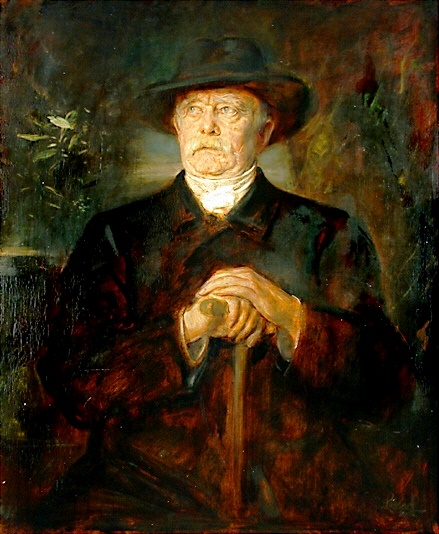
File:Franz von Lenbach Bismarck.jpg

In 1883 Chancellor Otto von Bismarck of Germany instituted the first national health insurance scheme, which would soon be followed by workplace accident insurance (workman's comp), unemployment insurance, and finally old age and disability insurance (social security) to put into place the first modern welfare state social insurance system which was eventually copied with success throughout the industrialized world.

Now Brad DeLong invokes his legacy in anticipation of Obamacare's likely success in wealthy, successful, highly educated blue states where The Powers That Be will actually try to make it work in contrast with its questionable nearterm future in struggling, dependent, low-educated red states where rejectionist, provincial governance (whose preferred legacies of propertarian statism seem to "range" from slavery to libertarianism) may lead to a slow motion electoral time lapse Wile E. Coyote moment for those "at fault":
In the Democratic-controlled “blue” states, where 60% of the US population lives – and which account for 70% of national income and 80% of its wealth – implementation of the ACA is likely to be like that of RomneyCare in Massachusetts: a somewhat bumpy ride, but a clear success that nobody will wish to repeal after the fact. But no one knows what will happen in the “red states,” where the Republican political infrastructure is digging in its heels.

What will doctors and hospital administrators in Phoenix, Kansas City, Houston, and Atlanta do after they talk to their colleagues in Los Angeles, Seattle, Minneapolis, Chicago, Baltimore, and New York, where state governments and political structures are trying to make ACA implementation a success? Will they compare and contrast the conditions under which they are working? Which candidates will they support with donations and votes in the 2014 and 2016 elections? What will nurses and patients denied the benefits of the ACA do?

America’s partisan heat is about to be turned up over the next several election cycles, as the blame game begins. Bismarck would know who is at fault.

Wednesday, February 28, 2007

Social Security, in Ecolanguage

Frequent econoblog commenter Lee Arnold's presentation is up on YouTube:

Saturday, September 30, 2006

Alicia Munnell on Social Security research

From her December 2000 survey:
Not only do studies show conflicting conclusions or different interpretations of existing information, but the sheer weight of the evidence makes it difficult to move. Any dramatic change in a large and important program is fraught with difficulties, and the more research that emerges the more the difficulties become apparent. Research also eliminates some of the simplistic arguments that would make privatization appealing. For example, work by Geanakoplos, Mitchell, and Zeldes (1998) carefully distinguishes between privatization, prefunding, and diversification and debunks the notion that privatization alone can lead to higher returns. My sense is that at least one if not more of the authors of that study may favor individual accounts, but their work demonstrates clearly that this preference has to be based on something other than an improvement in returns.


[Added to the 2000 Social Security Chronicle.]

Monday, July 31, 2006

Social Security Meta-Archive: 2006

[Part of The Earth-Based Initiative: Social Security Meta-Archive]

Social Security Meta-Archive: 2005

1/3
TIME TO PRIVATIZE SOCIAL SECURITY
Economist Dean Baker writing at MaxSpeak:

How would privatizing Social Security help? Well, I don’t mean the personal accounts idiocy, I mean making Social Security a private corporation that does the exact same thing the current program does, except have the organization that administers the program be a private company operating on contract with the government.

Then, when David Walker, Thomas Friedman, Peter Peterson, the Washington Post editorial board etc. make some outlandish claim about Social Security devastating the country, the company could sue them for libel, just as Microsoft would if they made an equally outlandish claim about that company’s impact. One or two lawsuits like this and these people would adhere much more closely to the truth, as would the newspapers and television stations that wholesale this tripe across the country.
1/4
DeanSpeak
Economist's View links to Dean Baker's response to Tom Friedman.
1/7
Goldilocks and the Three Social Security Bears
Bruce Webb at MyDD.
1/9
Private Pensions and Social Security "Reform"
Brad DeLong keys off of New York Times coverage of the decline of defined benefits packages to discuss the increasing value of social insurance.
1/10
Chile Confronts Problems Caused by Social Security Privatization
Economist's View links to New York Times coverage of problems with Chile's system.
1/16
Demography Is Not Destiny
Economist's View samples Paul Krugman and LA Times coverage of demography's impact on the budget.
1/20
The Rise Of Blogs
The National Journal on blogging's impact on the Social Security debate:
With such active readers, it made sense for bloggers to turn their attention to Washington -- and for more people inside the Beltway to awaken both to the influence of bloggers and the potential of blogging technology. That is exactly what happened after the 2004 election.Issues such as Social Security reform drove the interest in blogging and demonstrated the technology's power. George Washington University's Farrell said that blogs were very effective at "creating outrage and creating a groundswell" against Bush's plans for Social Security. Experts -- such as economics professor Brad DeLong of the University of California (Berkeley) and Max Sawicky, an economist at the Economic Policy Institute -- used their blogs to create a "testing bed for interesting arguments," Farrell said.

"We began to see those arguments being taken up by op-ed people ... and change the conventional wisdom in the media" about the Bush plan, Farrell said. Although the blogosphere alone did not push Social Security off the short-term agenda, it was a factor, he contended.

Andrew Roth, the government-affairs director at the conservative Club for Growth and the group's blogger, agreed -- to an extent. He said that Social Security reform is dead in Bush's second term not because of opposition from liberal bloggers but because Republican leaders lack the will to "force moderates to vote on it." Yet he also said that liberal bloggers "were far better organized and ready to fight than conservatives were."

The Club for Growth launched a group blog called Social Security Choice, and Roth expected more like it. "In fact, I was worried that somebody else was going to beat us to the punch. But that never happened, and the other blogs never materialized. I don't know why it didn't happen, but it was frustrating."
With Great Power Comes Great Responsibility
Brad DeLong responds:
Let me be more skeptical. The Bush administration did the heavy lifting, through failing to come up with a Social Security plan that anybody liked. You can get Congressmen to vote for tax cuts for the rich because the rich like tax cuts--and give campaign contributions. But who liked Bush's never-spelled-out Social Security plan? There is something to the idea that weblogs are contributing to the creation of a public sphere of debate and discussion at a more elevated level than the somewhat stylized, hieratic, and chronically-underbriefed-on-matters-of-policy-substance traditional media and opinionate. But there is not very much.
In comment, Barkley Rosser responds to DeLong:
think that Max deserves the prime place here. Certainly your blog is more read than his. But you must admit that for all your criticisms of the Bush non-plan, you have continued to argue that "something should be done," and have not ultimately gone back on those folks from the Clinton administration who really got all this nonsense going with their hysterically ridiculous projections as Social Security Trustees back in the late 1980s. What was with all that anyway? Those projections provided the base for the Bush nonsense.

The first to point out in print that those projections were ridiculous were the late Robert Eisner and then Dean Baker and his coauthor, Weissbart. Max and those on his blog, including Dean, were probably the first to give those a serious airing in public as Bush began his push. It is good that people like you and Krugman picked up on all that and helped get it out to the broader public.

So, Brad, you deserve some kudos, but please recognize that in fact nothing really needs to be done to social security. Do not provide ammo for a future Dem prez to come back with another round of this stuff.
...with follow-up by Bruce Webb:
Josh deserves full credit, and Matt and Kevin were relatively early adopters. But the real credit goes to the numbers. The entire Bush plan required all players to get on board the train before the release of the 2005 Social Security Report. March 23, 2005 was the day the music died for the Cato Institute. None of their plans survive encounter with the economic numbers.

The "No Economist Left Behind" contest settled one end of the logic fork that impaled privatizers. You don't get 6.5% returns across the boards with the productivity numbers of Intermediate Cost. And the business pages settled the other end of the logic fork. The economy will not perform down even to the level of fully funded Low Cost.

President Dole might have had a good shot in 1997, you had to be pretty optimistic about the economy to expect that we would beat a pretty good 1996 productivity number year in and year out. But we did. President Bush might have had a fair shot in 2001, you could squint and still make out "crisis". But at that point the economy had to seriously underperform to sustain "crisis". It didn't. Despite a worrisome disconnect between productivity and real wages by historical standards, the overall economy has continued to grow.

You can argue whether the 2001, 2002, 2003, 2004 Reports were deliberately manipulated. I believe they were, others are free to disagree. But there is no question about the 2005 Report. The 2004 Report predicted 2.7%, the real economy returned 3.3%, then the 2005 Report set 2.1% as the "optimistic" number. You don't even have to know what that number refers to, the Trustees expected us to believe that under the best case scenario it would shrink to 66% of the 2004 number. That's optimism?

In the event the relevant number is productivity as defined by the Trustees (somewhat different from productivity as defined by the BLS and reported in the papers). Nobody could defend the numbers in table V.B1 (Principal Economic Assumptions), no one even tried, not once.

The blogosphere and Congress can dislocate their shoulders patting themselves on the backs for delaying the departure of the Privatization Train until March 23, and good on them and us. But the real juice in the Third Rail of American Politics came in the form of a 216 page government report.
2/7
Stitching a New Safety Net
The Wall Street Journal's Econoblog features an exchange between Andrew Samwick and Mark Thoma.
2/8
This Week In Entitlement Reform
A quick survey by Dave Altig at macroblog.
2/9
Night of the Living Policy Proposal
Matthew Yglesias on the never-ending GOP impetus to pop-up zombie proposals.
Zombie Reforms, Zombie Arguments
Will Wilkinson of CATO says if Republicans won't "reform" Social Security, Democrats eventually will.
2/21
Daily Policy Digest
"Policy Notes" from the Pete du Pont-founded National Center for Policy Analysis.
3/31
Ramesh Ponnuru Is Off Message!
DeLong chastises NRO apparatchik for spilling the beans.
4/3
The Missing Social Security Trustees Report
Michael Hiltzik's Golden State blog.
4/17
Is There a Social Security Crisis?
zFacts.com
4/20
Defining the Social Security Privatization Debate
Mark Thoma links to an Economist's Voice article enumerating the seven attributes of privatization.
4/28
REFORMING SOCIAL SECURITY SOONER RATHER THAN LATER:
FACT AND FICTION

Jason Furman of the Center for Budget and Policy Priorities.
5/1
Social Security Report Released
Mark Thoma links to Angry Bear, triggering a long discussion of productivity.
5/2
The Trust Fund
More from Economist's View on the 2006 report.
5/13
Social Security
DeLong links to an announcement of an Andrew Samwick Social Security reform presentation, Samwick responds to Bruce Webb in comment:
Bruce writes:

"Will Andrew take table IV.B6 "Unfunded OASDI Obligations for 1935 (Program Inception) Through the Infinite Horizon" (2005 Report p. 59) to front a 3.5% payroll gap like he did on this site in November 2004 (thanks Brad I kept the e-mail) to sell his then solution?"

Answer: Yes. The 3.5% uses the intermediate assumptions to make a projection of the unfunded obligations that does not set an arbitrary stopping point that is 75 years in the future. A 75-year average is an inadequate summary of a series that has a trend.

Bruce writes:

"... there may be a alternate reality where a professional economist might decide to stop at IV.B6 on page 59 and not examine the numbers of V.A1 (Principal Demographic Assumptions) on pages 75-76 and ignore V.B1. But that would be sloppy at best and thoroughly dishonest at worst."

Answer: Obviously, projections for a less rapidly aging population or higher productivity growth would make Social Security more solvent over the projection period. I have discussed on my blog that I think the demographic assumptions (mortality) are too favorable and the economic assumptions (productivity) too unfavorable for Social Security's projections. See the following posts:

http://voxbaby.blogspot.com/2004/12/more-from-max-on-framing-social.html

http://voxbaby.blogspot.com/2005/01/more-on-life-expectancy-projections.html

http://voxbaby.blogspot.com/2005/01/victor-does-heavy-lifting.html

Bruce writes:

"Professor Samwick is not sloppy. Pretty damn slick in selling privatization, but not sloppy. Which still does not make the graph in Figure II.D7 go away."

Answer: I don't find the assumptions of the "low-cost" scenario reasonable, and so it is of little consequence that the trust fund is not projected to run down to zero in that case.

If I thought of myself as "selling" something, it would be this:

http://voxbaby.blogspot.com/2004/10/how-to-reform-social-security-part-i.html

and this:

http://voxbaby.blogspot.com/2004/10/how-to-reform-social-security-part-ii.html
Barkley Rosser responds to Samwick:
I have not looked at this year's report, but I looked pretty closely at last year's and have been following this ever since the Trustees first began issuing their goofy projections in the late 1990s. My understanding is that the numbers are not all that different from last year.

So, basically ever since these projections first appeared in the late 1990s, the intermediate projections have been for the economy to start growing at about half its historical rate in the near future. However, that near future never seems to arrive, except for the occasional recession year like 2001. I know this year the year of "bankruptcy" moved forward a year, but in most years these "crisis" dates have kept being pushed off.

I do note that you agree that the economic projections are probably too pessimistic. It may be true that the length of life projections are too "optimistic" (in the sense that people are predicted to die sooner than they will). But my memory is that there was also a projection of a drastic slowdown in immigration that was to occur in the near future, which also has not shown up yet. Well, who knows? Maybe this anti-immigration movement will really kick in, walls will get built, and we'll get the expected demographic crisis after all.

I basically have two observations (aside from noticing that medicare is in far worse shape and that is where the focus should be; it is already running a deficit).

1) There are quite a few countries out there that have the demographic ratios we are forecast to have three decades from now. Many of these countries have earlier retirement ages, longer life expectancies, and in some cases, much larger government paid old age pensions (nearly twice as high as ours in Germany, last time I checked). In none of these countries has the system "gone bankrupt" or are old people not getting their pensions.

Now, I am not suggesting that we should have Germany's system or some other country in Europe (most of those countries are trying to reduce the generosity of their systems and having trouble doing so). But it does seem that those selling "crisis" stories are simply way overexaggerating things.

2) Even if the more pessimistic scenarios do eventually come to pass. I do not see why we should be running out to "do something now." We are at least a decade away from the system even beginning to run a deficit (as medicare is doing right now, not to mention pretty much the entire rest of the US government). Why not wait and see if the more pessimistic trends emerge and then do something?

Given what happened over the last decade, it looks to me like the probability is very high (certainly higher than you think) that we will wake up a decade from now and find out that it has resembled this past one. That if we do nothing, we will find a cottage industry of people like you running around like Chicken Little warning about how the system will be going into deficit in 2027 and will be bust in 2050 and how we need to have a conference at this or that think tank to...

Greenspan and his crew fixed it in 1982, and so far it is very far from being broke.
Bruce Webb responds to Samwick:
"Answer: I don't find the assumptions of the "low-cost" scenario reasonable, and so it is of little consequence that the trust fund is not projected to run down to zero in that case."

Which ones are unreasonable? And why?

Low Cost has been a much more reliable predictor than Intermediate Cost in the ten years I have been following the numbers. Blithely waving that away by saying you don't find them "reasonable" buys you nothing. Bring numbers, explain which numeric series of Low Cost is too optimistic.

[Changes in trustees' projections over time]

Year in and year out the real economy has been outperforming Intermediate Cost, indeed it has been outperforming Low Cost. Why is the assumption that it will continue to do so, particularly when Low Cost calls for productivity growth no greater than 2.2% in any future, unreasonable?
Webb continues:
The 2006 Report presented 2.0% as the productivity number for 2005. The Trustees did not explain why productivity slumped from a reported 3.0% in 2004 or why this mysterious slump occured and yet did not have an effect on any number series that would cause someone to comment on it. They simply present the number.
[ECONOMIC ASSUMPTIONS AND METHODS] And then add this rather peculiar footnote:
"3. Historical data are not available for the full year. Estimated values vary slightly by alternative and are shown for the intermediate alternative."

One is left scratching one's head. Why on earth were "historical data" "not available"? Never seemed to be a problem before. Note that this does not equate to "productivity figures are subject to revision as more data comes in". This has always been true and merits no special recognition now.

What is the real function of footnote '3'? My only explanation is that it is meant to enter some dusty foggo into what should be a rational examination of actual economic numbers.
Barkley Rosser follows up:
I fully endorse Bruce's questions and comments to Andrew.

For the rest of you, be careful. Note that Brad put this up without snide or critical commentary. He has been part of this cottage industry for some time.

Dean Baker has pointed out that the Monica Lewinsky affair may have saved us from Clinton actually following through in the late 1990s on what we now know were off the wall pessimistic projections. It was people Clinton appointed to the SSA who started this baloney of overly pessimistic projections. This is a bipartisan hysteria, with Dem presidents the real danger. A Dem, especially Bill's wife, might feel the "need to show responsibility" and appeal to Wall Street money by pushing some garbage on this through.

The real irony of Bush's disastrous tour last spring for two months is that he did increase the number of people who agreed with the phoney baloney claim that "social security is in crisis," even as support for his plan, and for him more generally, went down. Dems will oppose any social security change while he is in office. But, if we have Hillary, or Mark, or Al, or John, or Wesley, or Russ, or another "showing responsibility" and backed by Brad DeLong and heavens knows who else from the Dem part of this ridiculous Cottage Industry, Wachet Auf!
5/22
Greg Mankiw Criticizes Lieberman, Bush, and Krugman...
DeLong links to Mankiw and cites Jason Furman in response.
SUPER-ANNUATED
MaxSpeak's take.
5/23
GOING ONCE, TWICE,A PENSION AT A PRICE
Tabloid story of Wall Street lawyer attempting to sell his Social Security benefits decades ahead of time on ebay.
6/19
Social Security Reform: A Bipartisan Proposal
AEI Webcast of presentation of Liebman-MacGuineas-Samwick Social Security plan.
Jason Furman x 2
Libertarian Arnold Kling living in The Furman Century.
6/26
Social Security Private Accounts: Add-ons and Carveouts
DeLong links to a presentation of Samwick's latest plan.
The Tree of Tax Hikes and Social Security Privatization
DeLong on the benefits of add-on accounts.
CATO GUY FOR HIGHER TAXES
MaxSpeak:
The dilemma of the privatizers is that current law favors the status quo, and eventually the use of income tax revenues, backed by the political clout of retired Baby Boomers, to maintain the program.

They've already lost. The might have lost in 1983, betrayed by one of their own -- Crazy Al and Ronald Reagan. Their reform commission may have been the last plausible chance to radically remake the program.

Now if you want reform, you have to accede to tax increases. Give us some revenue, and maybe we'll give you some itty bitty reform. Roll over and we'll rub your tummy too.
6/27
Talking Points Memo
Josh Marshall on Bush's latest phase-out attempt.
Can Social Security Reform Be Saved?
Capital right-wing outlet American Spectator on the Liebman-MacGuineas-Samwick "bipartisan" plan:
Since the LMS plan is a sincere effort at compromise, and since much of the left would still oppose it were Congress to seriously consider it, it would be worthwhile for those of us on the political right to contemplate just how much we would be willing to give up to achieve reform. Of most concern would be the increase in the earnings cap, a tax increase that would fall hard on small businessmen and women, some of conservatives' biggest supporters. Could we, say, accept a plan with only an add-on personal account in exchange for only a minimal rise in the earnings cap and the rest funded via debt? Or should we demand a carve-out in exchange for any increase in taxes?
7/2
Social Security Confusion from the American Spectator
Delong responds:
An increase in contributions coupled with diverting some of those contributions to private accounts is indeed "a carve-out... [plus] an increase in taxes." But the short way of describing "a carve-out... [plus] an increase in taxes'" is "an add-on." Hogberg's second question is essentially "should we accept an add-on?" The answer is yes.

Conversely, an unfunded add-on--a "personal account... funded via debt" that doesn't raise the resources devoted to funding the Social Security system--the short way to describe that is as a "carve-out." Hogberg's first question is "should we demand a carve-out?" The answer to that is no.

But should I be surprised that writers for the American Spectator are hopelessly confused, and call a carve-out an add-on and an add-on a carve-out? I think not.

Given how confused they are, why don't we good guys reframe the debate. An increase in contributions to the Social Security system is to require that current workers accept some of the responsibility for funding their own Social Security benefits, and not push it off onto future generations. Taking responsibility is supposed to be something that responsibility-loving Republicans favor, isn't it?
7/19
Stagnation Celebration
Dean Baker on the promise of productivity and demographics.
7/26
Pulling on Liberal Heartstrings
Economist's View on Social Security's purported threat to the world's poor.
Does Your Social Security Check Perpetuate Global Poverty?
Angry Bear's PGL tracks the argument.
Talking Points Memo
Josh Marshall on the latest instance of Social Security bamboozlement by GOP candidates remaining at large.
7/31
"We're Going to Get Serious"
Economist's View on the latest threats from John Boehner and Hank Paulson among others.
8/11
President Remains Eager to Cut Entitlement Spending
Michael Abramowitz's Washington Post coverage.
More "Entitlement" Nonsense at the Post
Dean Baker responds at his American Prospect Beat the Press blog:
Yet again the Post reports on the threat posed by “entitlement” spending, referring to Social Security, Medicare, and Medicaid. To quickly repeat myself, this is dishonest. There are modest and manageable increases in projected Social Security spending due to the aging of the population. There are unmanageable projected increases in Medicare and Medicaid expenditures due to a projected explosion in health care costs. If the projected explosion in health care costs proves accurate, then it will devastate the economy, and cause serious budget problems.

Honest people respond to these projections by examining ways to prevent the explosion in health care costs. Less honest people talk about the need to cut entitlement spending, including Social Security.
11/18
Who Needs Social Security?
Mark Thoma links to a Kotlikoff paper on high-earning households' dependency on Social Security.
Sunday, April 30, 2006

Social Security Meta-Archive: May 2005

[Part of the Social Security Meta-Archive: 2005]

Social Security Meta-Archive: April 2005

FIXING SOCIAL SECURITY [PDF]
Former Social Security Commissioner Robert Ball writing for the Century Foundation.
The Regressive Impact of the Progressive Indexation of Social Security Benefits [PDF]
Dean Baker of the Center for Economic and Policy Research

5/1
Warren Buffett and Charles Munger on Social Security
DeLong links to coverage of Buffett's opposition to privatization.
In Praise of Bush's Honesty (Honest)
Michael Kinsley.
SNATCHING DEFEAT FROM THE JAWS OF VICTORY WATCH
Max Sawicky responds.
5/2
Universalism and Social Security
Mark Schmitt at the Decembrist:

One fascinating aspect of the Bush campaign to privatize Social Security has been the desperate attempt to find some constituency, somewhere, for whom Social Security is a manifestly bad deal. And it's amazing how hard it has been for them to do it:

First there was the claim that it's a bad deal for African-Americans. That was one that you didn't know whether to laugh at or be offended by. (My colleague Marcellus Andrews probably did the best job of combining the two emotions.) Then there was the claim that it's a bad deal for younger workers, but that depends entirely on the premise that the government will chose to default on the Treasury bonds.

Finally, as you could see in Bush's press conference Thursday night they've identified a constituency that supposedly doesn't get a good deal from Social Security: It's a widow or widower whose spouse dies shortly before retirement. The surviving spouse would get either his/her own benefits, or the spouse's, whichever is higher, "but not both," as Bush points out. And that's true. Of course, if the spouse dies and leaves children under 18, survivor benefits under Social Security will be a lifesaver for the family. (As Hans Riemer of Rock the Vote points out, young people are familiar with Social Security and like it, because they think of it as the program that helped Johnny's family when his dad died.) And if the widow didn't put in at least ten years in the workforce herself, or didn't earn as much money, the benefits through her husband's Social Security are much more than she would get on her own. So, to summarize Bush, the person for whom Social Security is a raw deal would be a widow or widower whose spouse dies at, say, 60, after the kids are grown but before retirement, and in a household where both spouses worked for much of their adult lives at relatively comparable incomes. The system is "unfair" to that widow or widower, according to Bush, because she only gets Social Security benefits for one person, not two.

It's a pretty cool social program that's a good deal for everyone except a person in that particular situation. And what's so bad about one person's getting benefits for one person anyway?

(Of course, as was finally pointed out in the Senate Finance Committee hearing last week, the forced annuitization feature of private accounts means that they're not really inheritable either, at least not after the annuitization has occurred.)
A Gut Punch to the Middle
Paul Krugman on the effects of Bush's version of progressive indexing.
Krugman Clarifies Liberalism
A response at the blog JustOneMinute, triggering an extended comment thread.
Social Security's Progressive Paradox
Julian Sanchez of the libertarian magazine Reason disputes the insurance aspect of Social Security.
5/3
Talking Points Memo
Matthew Yglesias responds.
My Socks are Cold Feet Insurance!
Will Wilkinson, another libertarian, responds to Yglesias at The Fly Bottle:
Now, yes, it turns out that we don't know exactly how long we're going to live, and so there's some chance we might outlive our savings. Or we might face some kind of financial catastrophe that guts our retirement nest egg. You don't know how long you'll be able to be a productive contributor to the economy, etc. But the point that Matt fails to address is that insofar as Social Security "insures" against these contingencies, so does means-tested welfare, and to a very great extent, so do personal accounts. Means-tested benefits are much MORE like insurance in the sense they kick in only upon the occurrence of some kind of loss or hardship. An annuity from a personal retirement account is exactly like a stream of Social Security checks, except that you actually own something. If Social Security is insurance, then so is a personal account annuity. The reason why Feldstein, in his presidential address to the APA, "Rethinking Social Insurance" discusses the current system, personal accounts, and means-tested benefits as alternative forms of "insurance" is simply that if the current system counts as social insurance, then so do the alternatives.

Regular commercial insurance works by subsidies across the risk pool. (And is by its very nature "social.") Premiums are actuarially determined on the basis of bunch of variables like the probability of the occurrence of loss and the likely cost of reimbursing it. It's a kind of bet. The premiums of people who get lucky, and don't experience the relevant kinds of losses, reimburse people who get unlucky and do experience them.

Social Security isn't like this at all. It "reimburses" everyone who turns 65 (or 62 or 67). Like I said, this event isn't a loss; it is in fact correlated with being rich. A system that pays everyone--Warren Buffet, Tom Cruise, etc.-- is conspicuously un-insurance-like. It's sort of like a system of home-owners insurance where everybody's house burns down ten years after you move in. There's nobody who gets lucky, so no way to transfer risk across the pool. Rather than being structured at all like regular insurance, Social Security is a system of chained intergenerational transfers -- a chain letter, a Ponzi scheme -- which is not what insurance is.

If you insist on calling non-insurance insurance, then Social Security is like insurance in the way that any stream of income is like insurance. It makes it possible to pay for stuff that you wouldn't otherwise be able to pay for. But that's not what insurance is, except in the loosest possible sense. You don't think that you have insurance because you have a salary. You don't think you have disability insurance because you walk around with a helmet on. Most people who receive Social Security are perfectly able to "self-insure." And Social Security improves their ability to self-insure largely because it's replacing income that the government took away in the first place.

The point is: A system that pays everyone benefits upon the occurrence of a near-universal, non-loss event by means of a system of intergenerational wealth transfer just isn't insurance in the paradigmatic sense. If "insurance" just means "making sure that people don't suffer when they don't have enough money," then ANY system that makes sure that people have enough money is insurance. Inter-family transfers, churches, charities, clubs, etc. count as insurance in this sense. And so do means-tested old age benefits and personal retirement accounts.
In comment "Gareth" responds:
Libertarian: It's not an insurance system because people want to live to be old. That's not a risk.

Socrates: But outliving your savings is a risk. And an actuarially predictible one. So it makes sense to pool that risk. Which is what insurance is.

Libertarian: OK. I can imagine a private company providing that kind of service. But they would have to fund their future liabilities.

Socrates: Dude, Social Security funds its liabilities for years and could do so in perpetuity using slightly more optimistic assumptions. Anyway, if that's your problem, we can tinker a bit and solve it.

Libertarian: But Social Security can't have real assets...

Socrates: US Government Bonds aren't real assets? Would it bother you if the insurance company was 100% invested in US Government Bonds?

Former Libertarina, now anarcho-capitalist crazy: Beer funds! Repudiate the debt and give bondholders a share of Yellowstone!
...Expanded upon by R.J. Lehmann:
"Socrates: US Government Bonds aren't real assets? Would it bother you if the insurance company was 100% invested in US Government Bonds?"

In fact, most insurers are invested overwhelmingly in government bonds, and many invested solely in them.

I find the entire line of argument somewhat strange. Like most traditional pension systems, Social Security takes the form of an annuity, which is itself a form of insurance. Risk (in this case, the risk of outliving one's retirement savings) is transferred to a pool, and like most annuities, payouts then proceed from a given starting date until death.

In terms of long-term solvency, Social Security is not a particularly well-structured annuity plan, since the price is not rated according to the size of risk. If it were, then smokers would pay less than non-smokers, men pay less than women, etc. Although arguably, since payout adjustments are progressive with respect to income even without indexing, and the rich tend to live longer than the poor, that's at least one risk factor that is partially accounted for.

But that Social Security is a poorly structured annuity program doesn't mean it is NOT one. Most insurers, including life insurers who offer annuities, hedge against the risk of insolvency by way of reinsurance. The Social Security program's reinsurance is the American taxpayer...

PROGRESSIVE IS
Mad Max contrasts "liberal" and "social democratic" approaches to Social Security.
Pozen Pill
Brad DeLong, in Slate, on Pozen's ideas and what the Bush Administration may do with them.
Screwing the Very People Who Gave Him the "Mandate"
The Decembrist on the combined fiscal impact of Bush's SS and tax cut plans on the middle class.
5/4
Stanford Institute for Economic Policy Research
Audio and video of presentation by Peter Orszag and John Shoven.
Slashing Social Security: Bush Plan Cuts Benefits
Moving Ideas' page on the Bush Plan.
5/5
Let's Not Save Social Security
Mickey Kaus, writing in Slate, says keeping the option to slash Social Security deeper later this century is the top priority.
5/9
The Personal 'Lockbox'
John Fund of The Wall Street Journal proposes Treasury bill accounts.
Bush May Destroy Social Security, Not Fix It: John M. Berry
Bloomburg columnist on the ultimate political ramifications for Social Security implied by the rate of returns of progressive indexing.
The White House Mounts a Feeble Defense of Its Social Security Plans
Brad DeLong.
Give Us the Real Thing on Social Security
Will Wilkinson of the CATO Institute says Social Security is risky to its beneficiaries.
5/10
THE IMPACT OF THE PRESIDENT'S PROPOSAL
ON SOCIAL SECURITY SOLVENCY AND THE BUDGET

Jason Furman of The Center on Budget and Policy Priorities.
Index Fun
Matthew Yglesias in The American Prospect.
Progressive Price Indexing is Not Means-Testing -- It's Arbitrary
Peter Ferrara: Too Busy Being a Hack
The Decembrist.
5/11
Dems’ Plan
Stanley Kurtz of the National Review constructs a critique of Diamond-Orszag and Democratic stewardship thereof singularly lacking in, um, productivity.
5/12
Statement of C. Eugene Steuerle, Senior Fellow, Urban Institute, Codirector, Tax Policy Center, and Columnist, Tax Notes Magazine Testimony Before the House Committee on Ways and Means
Radio host Michael Medved's privatization meltdown
Media Matters coverage.
5/13
Statement on Social Security Reform
Brad DeLong testifies before the Democratic Policy Committee, followed by subsequent comment on the implications of assumptions of the distribution of returns from productivity for privatization in DeLong's blog by Bruce Webb:

From Michael Cain
"Is there a chance that, deep down, the Trustees realize that the portion of national income that goes to the capped wages and salary base for the SS taxes will be a shrinking one in the future? And that the "productivity" growth that they assume is actually that portion of the overall growth rate that will show up in that tax base?"

Well sure, but that is not the number they report in "productivity". The effect you mention would show up in other columns like Real Wage Differential. Productivity is the overall pie, the size of the slices depends on other factors. Lowballing the size of the pie because you know the people cutting the slices are rogues is to make a mockery out of the whole model.

We are talking about a spreadsheet. Intermediate Cost and Low Cost are nothing more than an Excel table. You change your initial assumptions and the changes ripple right through to the end. Productivity is just one assumption, though the driver, there are others and anyone if free to challenge them and show how they might offset productivity. But these tables are math and not psychology, they don't measure the evil that is in the hearts of men, they are not a scorecard on the Masters of Capitalism. They simply show that if you input a set of economic and demographic assumptions we can label A you get outcome X. If you input a different set of assumptions we label B you get outcome Y.

What you suggest here is that initial numbers are being distorted in an effort to hide the thuggery needed for Capital to extract all the gains of likely productivity over the next 75 years at the total expense of Workers. (Which was the outcome of the "No Economist Left Behind" challenge. You can save 6.5% stock returns with 1.6% productivity by putting 90% of America into perma-poverty). Well no thanks.

I assume that workers will extract some share (not necessarily a fair share) of the gains in productivity over the next years. Because despite the flaws both exhibit on a daily basis we still have some capital letter players called Democracy and Markets. And you can only game the latter so much before the former bites you in the ass.

Social Security insolvency requires one) that some future US government openly proclaim themselves to be thieves and liars and two) that corporate America will simply feel free to grind down American wages into the dirt. There are plenty of people who believe that, read any comment thread at dKos. But it is an uncomfortable starting position for privatizers. "Sure we will default on the bonds, and no you will never get a raise ever, but trust me with that 4% of your check"

You can only get to Social Security "crisis" by trashtalking the American economy and the whole concept of market wages. Ask the next privatizer you meet why he hates America so much.

Senate Democratic Policy Committee Hearing:"An Oversight Hearing on President Bush's Social Security Privatization Plan: Will You and Your Family Be Worse Off?"
5/16
"I Want My Safety Net"
"Why so many Americans aren't buying into Bush's Ownership Society" BusinessWeek cover story.
5/17
HEARING BEFORE THE SUBCOMMITTEE ON SOCIAL SECURITY OF THE COMMITTEE ON WAYS AND MEANS
U.S. HOUSE OF REPRESENTATIVES ONE HUNDRED NINTH CONGRESS FIRST SESSION

5/19
Pozen Blasts Bush Privatization Plans
The Center for American Progress reports on Pozen's opposition to "carved-out" accounts accompanying progressive indexing.
5/20
SOCIAL SECURITY, WHEN “NEVER” IS DEFINED AS "2042"
Team Bush propaganda methods dissected at the blog BE-THINK.
5/22
No Old-Age Security in the Private Sector Either
Joseph Stiglitz on dismantling public pensions and subsidizing private ones.
5/25
What Is the Social Security Trust Fund, Anyway?
Economist Andrew Samwick:

Think of the Trust Fund as a line of credit that the Social Security system extends to the rest of the government. The balance in the Trust Fund is simply the current value--principal plus interest credited at the Treasury bond rate--of all the withdrawals that the rest of the government has made historically on that line of credit to pay for things other than Social Security. Its projected balance at the end of the year is $1.85 trillion. Under current law, that balance is projected to peak at $3.61 trillion in 2022 before declining to zero in 2041. During those 20 years, the Social Security system will be calling in the loans that it has made to the rest of the government.

Keeping track of the total amount outstanding on these loans is the accounting purpose of the Trust Fund balance. It also has a legal purpose. Specifically, as long as the the Trust Fund balance is positive, then the system can pay the benefits implied by current law. It would require the Congress and the President to execute a new law to interrupt this process. When the Trust Fund hits zero, then it would take a new law to get full benefits paid on time--they would be paid only as tax revenues flow into the system.
Options for Social Security: Budgetary and Distributional Impacts[PDF]
CBO testimony before the Senate Finance Committee.
Retirement Income: The Crucial Role of Social Security
"An EPI news conference
Wednesday, May 25, 2005, 10 AM (ET)
National Press Club, Washington, D.C.

Co-authors Christian Weller and Edward N. Wolff discuss their new book, Retirement Income: The Crucial Role of Social Security
5/30
MORE MATH PROBLEMS AT THE POST
Dean Baker responds to a Washington Post editorial.
5/31
Privatization's Unintelligent Design
Greg Anrig, Jr. of TPMCafe on the "dynamic scoring" projections of Feldstein and Samwick.

Social Security Meta-Archive: 2005

Social Security Meta-Archive: April 2005

[Part of the Social Security Meta-Archive: 2005]

Social Security Meta-Archive: March 2005

April 2005
What is Progressive Price Indexing?[PDF]
Alicia Munnell of the Center for Retirement Research at Boston College.
4/1
A Proper April Fools Day!
Brad DeLong responds to Donald Luskin.
Stepford Town Meetings
EJ Dionne on Bush's employment of Secret Service as pep rally bouncers.
4/2
Asset Returns and Economic Growth
DeLong links to Mankiw's response to his paper with Baker and Krugman.
The Need for Social Insurance
Mark Thoma.
4/4
Prefunding and Private Accounts
DeLong quotes Andrew Samwick quoting Alex Tabarrok and responds.
4/5
Rove Says Social Security Overhaul Must Have Private Accounts
Bloomberg coverage.
4/6
The Commander Is on Deck
DeLong:"Gene Sperling issues marching orders on Social Security reform"
4/7
April Fools Day Continues!
DeLong:

Donald Luskin:
NRO Financial April 4, 2005: The actuaries, as noted earlier, assume about 1.9 percent annual real GDP growth over the coming 75 years.... At the same time, the actuaries assume 6.5 percent annual real total returns to stocks.... What’s the complaint, then? Where’s the inconsistency?..
Donald Luskin:
NRO Financial February 2, 2005: Krugman does make one good point... stock returns in the neighborhood of 6.5 percent will not be possible over the coming 75 years if economic growth is as low as the 1.9 percent rate used by the actuaries of the Social Security Administration in their solvency estimates...
There is one thing that puzzles me: Is Luskin genuinely too dumb to remember what he wrote two months ago? Or does he just think that National Review's readers and editors are too dumb to remember what he wrote two months ago?
Mark Thoma in comment:
Your reponse shows an admirable amount of restraint given the baseless hatchet job Luskin tried to do on your paper with Baker and Krugman, and the uncalled for personal attacks. He even pulled out the "Brad DeLong (the former Clinton administration official who is the self-confessed most-Marxist-leaning economist on the U.C. Berkeley economics faculty" which shows you just how scared you guys have him. Too bad he doesn't understand the point about social arrangements and modes of production you are trying to make in the post he links, and that what you write there is critical of, not supportive of, what most people think of as Marxian tenets.

A more honest link would have been to the comments on the transformation problem where Marxists are not happy with you...
George W. Bush's $1.7 Trillion Grand Larceny Spree
DeLong quotes Max Sawicky.
The Bush Administration Clown Show Continues...
DeLong articulates the implications of one of White House spokesman Chuck Blahous's talking points:
If you go to the real Republican economists, you will find the argument going something like this, where I have turned the frankness-and-blunt-speaking-o-meter up from its usual level of 3 to the Spinal Tap level of 11:

  1. Currently, the U.S. government is running a Social Security surplus--taking in more in Social Security taxes than it spends in benefits.

  2. When the baby-boom generation retires, the U.S. government is going to be spending more on Social Security than it will take in in taxes--so the government is going to have to borrow a lot of money in order to cover the deficit.

  3. The government will only be able to borrow if creditors think (i) the debt is not already too high and (ii) the government will have the will to levy taxes to pay us off when our bonds come due.

  4. Thus it's important that now--when Social Security is in surplus--that the government be not running up but running down the debt.

  5. If the government takes the current Social Security surplus and spends it--doesn't run a big current surplus and buy back debt now--then it will be unable to borrow when the baby-boom retirement payments come do because the debt level from which we will then start will be too high.

  6. The U.S. government--especially Frist, Hastert, Delay, and Bush--have a demonstrated incapability to not spend the Social Security surplus: there is no a snowball's chance in hell that a government run by them will buy back debt.

  7. So we are in big trouble.

  8. If only we could keep Frist, Hastert, Delay, and Bush from knowing that they have a Social Security surplus to spend, they would be forced to raise taxes or cut spending, and then the government would be able to borrow in the future to meet its Social Security obligations to the baby boomers.

  9. So let's set up private accounts. That will cut government revenues now--and so eliminate the Social Security surplus. Frist, Hastert, Delay, and Bush will be forced into fiscal sanity, and so we'll have a lower debt when we really do have to borrow in the future. And we won't have to borrow any more in the future as a result of our private accounts plan because we will cut normal benefits by an amount that is in present value equal to the amount that we're diverting to private accounts.
"Battlepanda" in comment:
Alan Greenspan in '83: Let me put this cookie away for you so you can have it for dessert later instead of ruining your dinner.

Al Gore in 2000: I wouldn't keep the cookie jar right out in plain sight if I were you.

George Bush in 2005: Oh uh! Somebody ate your cookies! Or perhaps your cookies never existed in the first place.

American people: Why preznit hand in cookie jar?

GB: To make sure this terrible terrible thing never happens again, next time we're going to keep the cookies in a jar with your name on it!

American people: (...)
4/8
The Bush Administration Social Security Clown Show Continues
DeLong links to Judd Legum and resumes bashing Blahous.
4/9
Losing the Social Security Battle
Stephen Moore, longtime libertarian think-tank operative, lays longterm plans for the destruction of Social Security in the Weekly Standard:
Finally, to put the Democratic obstructionists in an especially uncomfortable position, it would make sense to start proposing fallback positions that at least get personal accounts started. One idea would be to defuse the fatuous "risky stock market" argument by simply offering a plan where workers can have a private account, but are permitted to purchase only Treasury bills. Take the stock market out of the equation and there is not even the odor of risk with personal accounts.
THE COMMONWEAL
STRIKES BACK

Max Sawicky responds:
But . . . but . . . I thought Government bonds were "just IOUs"?!?

Steve and his boyz are in it for the long haul. Let's back up and see where we are.

At the least, the privatizers have helped to back the public into the Dems' position: there is a problem but not a crisis. So we are still ripe for misguided efforts to close deficits that are decades in the future.
4/14
A Note: Returns, Growth, and Financing Social Insurance
DeLong follows up on his paper on asset returns with Krugman and Baker.
4/15
"Asset Returns and Economic Growth": The Econ 1 Version
DeLong continues...
4/19
The focus groups speaketh
The Carpetbagger Report on "privatization" morphing into "personal accounts" morphing into "modernization."
Live Blogging from Heritage, III: The Demographics of the International Pension Situation
"This session is led by Richard Jackson, Director, Global Aging Initiative at the Center for Strategic and International Studies (CSIS). He's going to put the SS reform debate here in international perspective..."
4/22
Jackie Calmes on Chuck Blahous
DeLong links to Wall Street Journal coverage and comments:
A Social Security reform plan that does not preserve a defined benefit component, does not offer a good deal to the non-rich choosing private accounts, and does not boost national savings is not a Social Security reform plan worth proposing. There are no reasons for anybody to support this thing.
4/24
Matt Miller: Why Are Republican Economists Averse to Raising National Savings?
DeLong links to a discussion of the White House refusal to pay for private accounts.
4/26
FDR's Card Trick
A conservative attack on Social Security by William Voegeli of the Clairmont Institute writing at OpinionJournal.com
Social Security Reform
Peter Orszag testifies before the Senate Finance Committee.
Personal Accounts Are Not A Certainty
Washington Post coverage.
4/28
Press Conference of the President
Remarks on Social Security:

Congress also needs to address the challenges facing Social Security. I've traveled the country to talk with the American people. They understand that Social Security is headed for serious financial trouble, and they expect their leaders in Washington to address the problem.

Social Security worked fine during the last century, but the math has changed. A generation of baby boomers is getting ready to retire. I happen to be one of them. Today there are about 40 million retirees receiving benefits; by the time all the baby boomers have retired, there will be more than 72 million retirees drawing Social Security benefits. Baby boomers will be living longer and collecting benefits over long retirements than previous generations. And Congress has ensured that their benefits will rise faster than the rate of inflation.

In other words, there's a lot of us getting ready to retire who will be living longer and receiving greater benefits than the previous generation. And to compound the problem, there are fewer people paying into the system. In 1950, there were 16 workers for every beneficiary; today there are 3.3 workers for every beneficiary; soon there will be two workers for every beneficiary.

These changes have put Social Security on the path to bankruptcy. When the baby boomers start retiring in three years, Social Security will start heading toward the red. In 2017, the system will start paying out more in benefits than it collects in payroll taxes. Every year after that the shortfall will get worse, and by 2041, Social Security will be bankrupt.

Franklin Roosevelt did a wonderful thing when he created Social Security. The system has meant a lot for a lot of people. Social Security has provided a safety net that has provided dignity and peace of mind for millions of Americans in their retirement. Yet there's a hole in the safety net because Congresses have made promises it cannot keep for a younger generation.

As we fix Social Security, some things won't change: Seniors and people with disabilities will get their checks; all Americans born before 1950 will receive the full benefits.

Our duty to save Social Security begins with making the system permanently solvent, but our duty does not end there. We also have a responsibility to improve Social Security, by directing extra help to those most in need and by making it a better deal for younger workers. Now, as Congress begins work on legislation, we must be guided by three goals. First, millions of Americans depend on Social Security checks as a primary source of retirement income, so we must keep this promise to future retirees, as well. As a matter of fairness, I propose that future generations receive benefits equal to or greater than the benefits today's seniors get.

Secondly, I believe a reform system should protect those who depend on Social Security the most. So I propose a Social Security system in the future where benefits for low-income workers will grow faster than benefits for people who are better off. By providing more generous benefits for low-income retirees, we'll make this commitment: If you work hard and pay into Social Security your entire life, you will not retire into poverty. This reform would solve most of the funding challenges facing Social Security. A variety of options are available to solve the rest of the problem, and I will work with Congress on any good-faith proposal that does not raise the payroll tax rate or harm our economy. I know we can find a solution to the financial problems of Social Security that is sensible, permanent, and fair.

Third, any reform of Social Security must replace the empty promises being made to younger workers with real assets, real money. I believe the best way to achieve this goal is to give younger workers the option, the opportunity if they so choose, of putting a portion of their payroll taxes into a voluntary personal retirement account. Because this money is saved and invested, younger workers would have the opportunity to receive a higher rate of return on their money than the current Social Security system can provide.

The money from a voluntary personal retirement account would supplement the check one receives from Social Security. In a reformed Social Security system, voluntary personal retirement accounts would offer workers a number of investment options that are simple and easy to understand. I know some Americans have reservations about investing in the stock market, so I propose that one investment option consist entirely of Treasury bonds, which are backed by the full faith and credit of the United States government.

Options like this will make voluntary personal retirement accounts a safer investment that will allow an American to build a nest egg that he or she can pass on to whomever he or she chooses. Americans who would choose not to save in a personal account would still be able to count on a Social Security check equal to or higher than the benefits of today's seniors.

In the coming days and weeks, I will work with both the House and the Senate as they take the next steps in the legislative process. I'm willing to listen to any good idea from either party.

Too often, the temptation in Washington is to look at a major issue only in terms of whether it gives one political party an advantage over the other. Social Security is too important for "politics as usual." We have a shared responsibility to fix Social Security and make the system better; to keep seniors out of poverty and expand ownership for people of every background. And when we do, Republicans and Democrats will be able to stand together and take credit for doing what is right for our children and our grandchildren.
The Bush Social Security Clown Show Continues
DeLong responds.
4/29
It's the Circular Firing Squad of Flying Attack Monkeys!
More from DeLong in response to the press conference.
HOW WOULD THE PRESIDENT’S NEW SOCIAL SECURITY PROPOSALS
AFFECT MIDDLE-CLASS WORKERS AND SOCIAL SECURITY SOLVENCY?

Jason Furman of the Center on Budget and Policy Priorities.
INDEX THIS
Max Sawicky on the implications of progressive indexing.
Has Bush gone Commie?
The conservative blogger ProfessorBainbridge riffs off of the Voegli attack on Social Security to rub his hands in glee at the thought of subverting the "universalist" principle behind the implementation of Social Security in the US.
NOT DEMOGRAPHY
Max Sawicky links to a report by EPI's Josh Bivens.

Social Security Meta-Archive: May 2005

Monday, February 20, 2006

...And...And...A PONY!... With a SHINY NEW COAT!

Well, I don't know if it's the "best weblog post ever", but this Belle Waring post from a couple of years ago is good enough to reproduce here until Echelon enables "neutralize" or Blogger eats it, whichever comes first:
I think Matthew Yglesias' response to Josh Chafetz' exercise in wishful thinking was about right, even if Brad DeLong's is more nuanced. I'd like to note, though, that Chafetz is selling himself short. You see, wishes are totally free. It's like when you can't decide whether to daydream about being a famous Hollywood star or having amazing magical powers. Why not -- be a famous Hollywood star with amazing magical powers! Along these lines, John has developed an infallible way to improve any public policy wishes. You just wish for the thing, plus, wish that everyone would have their own pony! So, in Chafetz' case, he should not only wish that Bush would say a lot of good things about democracy-building and fighting terrorism in a speech written for him by a smart person, he should also wish that Bush should actually mean the things he says and enact policies which reflect this, and he should wish that everyone gets a pony. See?

John came up with this "and a pony" scheme during a discussion we were having about crazy libertarians. (He was bathing Zoë as I told him about the article I'd read, and Zoë chimed in that she wanted to get a pony too. Duly noted.) Reason recently published a debate held at its 35th anniversary banquet. The flavor of this discussion is indescribable. In its total estrangement from our political and social life today, its wilfull disregard of all known facts about human nature, it resembles nothing so much as a debate over some fine procedural point of end-stage communism, after the state has withered away. Child-care arrangements, let's say. Position A: there will be well run communal creches! Position B: nonsense! the amount of work required from each individual to maintain a perfectly functioning society will be so small that people can care for their own children and those of others on a spontaneous basis, as the need arises!

Allow me to summarize.

Richard A. Epstein: even in the libertarian utopia, some forms of state coercion will be required. If we must assemble 100 plots of land to build a railway which will benefit all, and only 99 owners will sell, then we may need to force a lone holdout to accept a fair price for his land. Similarly, the public enforcement of private rights and the creation of infrastructure will require money, so there will have to be some taxes. [Note to self: no shit, Sherlock.]

Randy Barnett: Not so fast! Let's cross that bridge when we come to it rather than restricting liberty in advance. We'll know a lot more about human liberty in the libertarian utopia, and private entrepreneurs will solve these problems somehow without our needing to grant to governments the dangerous ability to confiscate our property in the name of some nebulous "public good." And as for rights enforcement --look it's Halley's Comet!

David Friedman: Epstein places too much confidence in his proposed restrictions on government power. Rights could be enforced privately, and imperfect but workable solutions to the holdouts in the railway case could also be found. "To justify taxation we need the additional assumption that rights enforcement cannot be done by the state at a profit, despite historical examples of societies where the right to enforce the law and collect the resulting fines was a marketable asset."

Now, everyone close your eyes and try to imagine a private, profit-making rights-enforcement organization which does not resemble the mafia, a street gang, those pesky fire-fighters/arsonists/looters who used to provide such "services" in old New York and Tokyo, medieval tax-farmers, or a Lendu militia. (In general, if thoughts of the Eastern Congo intrude, I suggest waving them away with the invisible hand and repeating "that's anarcho-capitalism" several times.) Nothing's happening but a buzzing noise, right?

Now try it the wishful thinking way. Just wish that we might all live in a state of perfect liberty, free of taxation and intrusive government, and that we should all be wealthier as well as freer. Now wish that people should, despite that lack of any restraint on their actions such as might be formed by policemen, functioning law courts, the SEC, and so on, not spend all their time screwing each other in predictable ways ranging from ordinary rape, through the selling of fraudulent stocks in non-existent ventures, up to the wholesale dumping of mercury in the public water supplies. (I mean, the general stock of water from which people privately draw.) Awesome huh? But it gets better. Now wish that everyone had a pony. Don't thank me, Thank John.

UPDATE: John wants me to point out that he got the idea from a Calvin and Hobbes strip in which little Susie first wishes that Calvin was nicer, then realizes she might just as well wish for a pony while she's at it. So, thank that Calvin and Hobbes guy, or something.

2ND UPDATE: Thanks to Ben Wolfson for alerting us to the miracle of searchable Calvin and Hobbes! (Now get to work on your abandoned wasteblog, Ben.) Here is the original 'might as well wish for a pony' strip. I humbly submit that it deserves to be a catch-phrase. Just say 'plus a pony' on suitable occasions and watch your opponents whither away like the state itself.

Sunday, February 19, 2006

...But you'll have a SHINY NEW COAT!

Friedman's 'heresy' hits mainstream
A brief San Francisco Chronicle profile of Milton Friedman from last June:
President Bush's proposal to incorporate private accounts in the giant retirement program is easily traced to Friedman.

"He's the originator of it and all the discussion can be traced back to him," said the Cato Institute's Michael Tanner, a leading advocate of partial privatization.

"I've always been opposed to Social Security," Friedman said in a recent interview at his home in San Francisco. "I think it's a very unethical program. "
This link NOT sponsored by ALPO.


[Added to the 2005 Social Security Meta-Narrative]

Wednesday, February 08, 2006

Dwight Eisenhower on the Texas challenge to social democracy

Letter To Edgar Newton Eisenhower, November 8, 1954
From the Presidential Papers of Dwight David Eisenhower:
Now it is true that I believe this country is following a dangerous trend when it permits too great a degree of centralization of governmental functions. I oppose this--in some instances the fight is a rather desperate one. But to attain any success it is quite clear that the Federal government cannot avoid or escape responsibilities which the mass of the people firmly believe should be undertaken by it. The political processes of our country are such that if a rule of reason is not applied in this effort, we will lose everything--even to a possible and drastic change in the Constitution. This is what I mean by my constant insistence upon "moderation" in government. Should any political party attempt to abolish social security, unemployment insurance, and eliminate labor laws and farm programs, you would not hear of that party again in our political history. There is a tiny splinter group, of course, that believes you can do these things. Among them are H. L. Hunt (you possibly know his background), a few other Texas oil millionaires, and an occasional politician or business man from other areas. Their number is negligible and they are stupid.
[Associated Snopes coverage]


[Added to the Social Security Meta-Archive]

Saturday, November 26, 2005

Social Security Meta-Archive: 1999

[Part of The Earth-Based Initiative: Social Security Meta-Archive]

Winter

Will aging baby boomers bust the federal budget?[PDF]
Ronald Lee and Jonathan Skinner.

January

SOCIAL SECURITY PRIVATIZATION: EXPERIENCES ABROAD
CBO analysis.
1/20
State of the Union address
Bill Clinton discusses his plan:

With the number of elderly Americans set to double by 2030, the baby boom will become a “senior boom.” So first and above all, we must save Social Security for the 21st century. (Applause.)

Early in this century, being old meant being poor. When President Roosevelt created Social Security, thousands wrote to thank him for eliminating what one woman called the “stark terror of penniless, helpless old age.” Even today, without Social Security, half our nation's elderly would be forced into poverty.

Today, Social Security is strong. But by 2013, payroll taxes will no longer be sufficient to cover monthly payments. And by 2032, the trust fund will be exhausted, and Social Security will be unable to pay out the full benefits older Americans have been promised.

The best way to keep Social Security a rock-solid guarantee is not to make drastic cuts in benefits; not to raise payroll tax rates; and not to drain resources from Social Security in the name of saving it.

Instead, I propose that we make the historic decision to invest the surplus to save Social Security.

Specifically, I propose that we commit 60 percent of the budget surplus for the next 15 years to Social Security, investing a small portion in the private sector just as any private or state government pension would do. This will earn a higher return and keep Social Security sound for 55 years.

But we must aim higher. We should put Social Security on a sound footing for the next 75 years. We should reduce poverty among elderly women, who are nearly twice as likely to be poor as our other seniors — and we should eliminate the limits on what seniors on Social Security can earn.

Now, these changes will require difficult but fully achievable choices over and above the dedication of the surplus. They must be made on a bipartisan basis. They should be made this year. So let me say to you tonight, I reach out my hand to all of you in both houses and both parties and ask that we join together in saying to the American people: We will save Social Security now.

Now, last year, we wisely reserved all of the surplus until we knew what it would take to save Social Security. Again, I say, we shouldn't spend any of it, not any of it, until after Social Security is truly saved. First things first. Second, once we have saved Social Security, we must fulfill our obligation to save and improve Medicare. Already, we have extended the life of the Medicare trust fund by 10 years — but we should extend it for at least another decade. Tonight I propose that we use one out of every six dollars in the surplus for the next 15 years to guarantee the soundness of Medicare until the year 2020.

But again, we should aim higher. We must be willing to work in a bipartisan way and look at new ideas, including the upcoming report of the bipartisan Medicare commission. If we work together, we can secure Medicare for the next two decades and cover the greatest growing need of seniors — affordable prescription drugs.

Third, we must help all Americans, from their first day on the job, to save, to invest, to create wealth. From its beginning, Americans have supplemented Social Security with private pensions and savings. Yet today, millions of people retire with little to live on other than Social Security. Americans living longer than ever simply must save more than ever.

Therefore, in addition to saving Social Security and Medicare, I propose a new pension initiative for retirement security in the 21st century.

I propose that we use a little over 11 percent of the surplus to establish universal savings accounts — USA accounts — to give all Americans the means to save. With these new accounts, Americans can invest as they choose, and receive funds to match a portion of their savings, with extra help for those least able to save.

USA accounts will help all Americans to share in our nation's wealth, and to enjoy a more secure retirement. I ask you to support them.

Fourth, we must invest in long-term care. I propose — I propose a tax credit of $1,000 for the aged, ailing or disabled and the families who care for them. Long-term care will become a bigger and bigger challenge with the aging of America — and we must do more to help our families deal with it.

I was born in 1946, the first year of the baby boom. I can tell you that one of the greatest concerns of our generation is our absolute determination not to let our growing old place an intolerable burden on our children and their ability to raise our grandchildren. Our economic success and fiscal discipline now give us an opportunity to lift that burden from their shoulders and we should take it.

Saving Social Security and Medicare, creating USA accounts — this is the right way to use the surplus. If we do so — if we do so — we will still have the resources to meet critical needs in education and defense. And I want to point out that this proposal is fiscally sound. Listen to this: If we set aside 60 percent of the surplus for Social Security and 16 percent for Medicare, over the next 15 years that saving will achieve the lowest level of publicly held debt since right before World War I, in 1917.

So With these four measures — saving Social Security, strengthening Medicare, establishing the USA accounts, supporting long-term care — we can begin to meet our generation's historic responsibility to establish true security for 21st century seniors.
1/25
Washingtonpost.com: Social Security Special Report
2/2
Conservatives Should Stop Complaining and Liberals Should Start
[Suite101 discussion]
Discussion of the inescapable burdens of funding the retirement of future generations whether there is a Social Security or not.
2/5
New Economists' Petition
Economist Max Sawicky posts a petition to the Post-Keynesian Thought discussion list:


MASSACHUSETTS INSTITUTE OF TECHNOLOGY

DEPARTMENT OF ECONOMICS
50 MEMORIAL DRIVE
CAMBRIDGE MASSACHUSETTS 02142-1347

2 February 1999


Dear Fellow Economist:

We would like to invite you to join us in support of President Clinton's proposal to save the projected federal budget surplus. Economists have been arguing for decades that increased national saving is the only way to prepare for the retirement of the baby boom, and we believe that it would be helpful for economists to endorse the President's major saving initiative.

If you are willing to add your name to the list, please sign the attached statement and fax it to Jennifer Cloherty at (617) 552-1750.

Sincerely,

Robert Solow

Peter Diamond

Alicia Munnell


The text of the proposed open letter is:


PRESIDENT CLINTON'S PROPOSAL TO SAVE SURPLUSES IS GOOD ECONOMICS

President Clinton has made the correct decision in his budget proposal, namely, to save most of the $4.4 trillion of the net budget surpluses projected by the Administration of the next 15 years. Instead of using this money for tax cuts or unproductive spending, the government will use the bulk of it to buy back government debt, reducing debt in the hands of the public from 44 percent of GDP today to about seven percent in 2014, according to Administrative estimates. This will free up trillions in the hands of private investors who will be able to lend the money to businesses for investment in new plant and equipment.

Saving and investing now is the only real way to prepare for the retirement of the baby boomers. Saving now will increase the ability of the economy to produce food, shelter and clothing in the future. Although no one can predict how large the budget surpluses will turn out to be, we can be sure that saving them by reducing outstanding government debt is an excellent way to ease the burden on future workers of supporting an aging population.


Please add my name to the list of economists supporting the President's initiative to save the projected budget surpluses.


Name (please print)


Signature


Date


Signers of Open Letter Regarding President Clinton's Proposal to Save the Budget Surplus as of 11:00 AM Feb. 5, 1999.

Name and Affiliation

Aaron, Henry, The Brookings Institution
*Arrow, Kenneth, Stanford University
Baily, Martin Neil, McKinsey and Co., Inc.
Basu, Susanto, University of Michigan
Blinder, Alan, Princeton University
Bosworth, Barry, The Brookings Institution
Burtless, Gary, The Brookings Institution
De Long, J. Bradford, University of California at Berkeley
Diamond, Peter, Massachusetts Institute of Technology
Dornbusch, Rudiger, Massachusetts Institute of Technology
Duesenberry, James, Harvard University
Froot, Kenneth, Harvard University
Griliches, Zvi, Harvard University
Gruber, Jonathon, Massachusetts Institute of Technology
Haveman, Robert, University of Wisconsin
Ibbotson, Roger, Yale University
Joskow, Paul L., Massachusetts Institute of Technology
*Klein, Lawrence R., University of Pennsylvania
Levy, Frank, Massachusetts Institute of Technology
Munnell, Alicia, Boston College
Perry, George L, The Brookings Institution
Rose-Ackerman, Susan, Yale University
*Samuelson, Paul, Massachusetts Institute of Technology
Shapiro, Matthew, University of Michigan
Shiller, Bob, Yale University
*Solow, Robert, Massachusetts Institute of Technology
Summers, Anita, University of Pennsylvania
Summers, Robert, University of Pennsylvania
*Tobin, James, Yale University
Tyson, Laura D., University of California at Berkeley
Wolfe, Barbara, University of Wisconsin

*Nobel Prize Winner

Re: New Economists' Petition
Paul Davidson, of the JOURNAL OF POST KEYNESIAN ECONOMICS, drafts a response:

Mr. President:

One of the most astute students of the Social Security system, Robert Eisner (former President of the American Economic Association) published an article debunking many of the false claims made by those who proclaim themselves to be Saviors of the Social Security System. just a few weeks before he died in the Fall of 1998. In this open letter we take urge you to listen to this intelligent voice that has unfortunately been stilled.

Eisner stated:
Social Security faces no crisis now or in the future. It will not "go bankrupt." It will "be there," not only for those of us now enjoying it or looking forward to it in the near future, but for the baby-boomers and the "Generation-X" following them. All this is true as long as those who would nibble away at Social Security or destroy it ... do not have their political way.
The proposed nibbling away of Social Security, including that by some of its presumed friends, is disingenuous and misleading. Even some of its defenders seem all too ready to accept "minor" cuts in benefits to achieve prospective fund balance.

The notion that Social Security faces bankruptcy begins with a fundamental misconception, that payment of benefits somehow depends upon the OASDI (Old Age and Survivors and Disability Insurance) trust funds. The trust funds are merely accounting entities.

Social Security payments are an obligation under law of the U.S. Government. Our government and its Treasury will not, indeed cannot go bankrupt. As Federal Reserve Chairman Alan Greenspan has recently put it, "...[A] government cannot become insolvent with respect to obligations in its own currency."

For those concerned, nevertheless, about the "solvency" of the trust funds there are simple, painless remedies for this accounting problem.

The whole problem, though, is trivial. That projected shortage in the trust funds in 34 years--aside from the uncertainty of any such long-run projections--is purely a matter of accounting, with any number of easy accounting solutions.

It was not God but the Congress and the Treasury that determined the interest rate to be credited on the non-negotiable Treasury notes of the fund balances. As Alan Greenspan has pointed out, this would merely change the identity of those who hold government bonds as against stocks, with little or no real effect on the economy. .

If we want Social Security to share in whatever earnings investors are receiving, why not award balances in the Trust funds, instead of the current 5.9 percent interest rate on long-term government bonds, the higher returns that might be earned in equity investment? Barry Anderson, until recently top civil servant in the Office of Management and Budget, has calculated that crediting the balances with a 10.4 percent interest rate, which is close to the long-run return on stocks, would keep the funds in balance indefinitely, on the basis even of those pessimistic "intermediate" projections. This would again be merely a matter of accounting, with no real effect on the measured budget deficit, the Federal debt held by the public or the economy. But it would solve that presumed problem of a future shortage in the Trust funds. Then, if we really cared about the welfare of Social Security contributors, we would increase their benefits to match these higher earnings.

The fears and cynicism regarding Social Security, misguided as they are, though, should be met as fully as possible. Here is a way to do it and truly, in President Clinton's words, "Save Social Security first." It is immediate, effective and painless! And it will entail no cuts in benefits, no new taxes and no use of the developing budget surplus.

1. Convert all of the balances of non-marketable Treasury securities currently in the funds' accounts, now over $600 billion, into marketable Treasury securities, guaranteed like all others by the full faith and credit of the United States Government. Set the interest rate on these securities at 10.4 percent, sufficient to guarantee long-run solvency according to the Intermediate-Cost projections, and not inappropriate in view of past long-run market returns on equity.

2. Have the trust funds make all payments to beneficiaries and receive all revenues currently credited to them. These would include the interest on their existing balances. The funds' assets of marketable securities would continue to grow as long as funds' incomes exceed their outlays.

3. Have the trust funds sell securities to meet any cash shortfall if, or whenever, income becomes less than outgo. According to those Intermediate-Cost projections, this would begin to become necessary in 2019, when the funds' balances would be $2.9 trillion.

The legitimate concerns of millions of Americans that their retirement income may not prove adequate can be met by adding to Social Security, not cutting it or substituting the vagaries and--for most--the confusions and costs of private investment. I have proposed adding to the Social Security system a program of voluntary additional contributions.

Privatizers do have a point though. Average Social Security benefits are too low, coming now to only about $10,000 for a family with a retired worker. Millions of middle-class Americans are concerned that their retirement income will be inadequate.

There is a way to meet their needs and aspirations, a way that would take not one penny from Social Security but would offer all the promised benefits of privatization. I would propose what might be called "publicization."

I would offer all participants in the Social Security system--which I would hope would encompass virtually the entire population, including those who earn their income from capital without working--the chance to make additional, entirely voluntary contributions to Social Security. These would be credited to their individual Social Security accounts. And they would be invested, by choice of the participant, in: a) a passive, indexed stock fund; b) a passive, indexed bond fund; or c) Treasury securities. Contributions could be made not only by the self-employed and employees themselves, but by employers on behalf of their employees; employers might find offering such fringe benefits a cost-effective way of recruiting and retaining workers.

The contributions would be tax-deductible, like current IRAs and 401(k)s but ultimate benefits would be taxable. The contributors' accounts would be credited with the income and capital gains on their investments, whatever they were, both up to retirement and afterward. They would, on retirement, receive actuarially fair annuities with cost-of-living adjustments or, better, adjustments related to changes of wages of those working.

We would then have the best of all worlds. Most important, the retirement benefits of tens of millions of Americans would be increased. We would preserve fully the social insurance of our existing Social Security system. We would encourage private saving and investment.

That burden can be eased, now and in the future, by adding to the total wealth of our nation. It means providing for more workers and making them more productive. It means provision of quality child care, permitting reasonable immigration, maintaining full employment, and investing in research and the human capital of education and health of our people. These measures, and not decimating or destroying Social Security, are the ways to advance our future.

Paul Davidson
Holly Chair of Excellence in Political Economy
Editor, JOURNAL OF POST KEYNESIAN ECONOMICS [JPKE]
2/8
The Real Threat to Social Security
Robert Dreyfuss, in The Nation, on the movement behind privatization and the Clinton administration response.
2/11
The Biggest Ponzi Scheme on Earth
Milton Friedman argues there's no better reason to socialize risk for retirement security than for housing or transportation.
5/1
Two Cheers for Clinton's Social Security Plan
Dean Baker.
5/11
Risk and Returns of Stock Market Investments Held in Individual Retirement Accounts
Economist Gary Burtless of Brookings Institution testifies before Task Force on Social Security Reform, House Budget Committee, on returns from stocks and their implication for Social Security reform.
5/26
Should We Retire Social Security?[PDF]
Henry Aaron and Robert Reischauer in Brookings Review
6/12
Shameful Moments in Economics I: The Social Security Debate
Economist Dean Baker witnesses to his own experience in the Social Security debate.
September
The Changing Economics of Social Security and Retirement Plan Sponsorship
Social Security's historic impact on defined private benefit plans from Watson Wyatt Insider partially based on the book by Sylvester J. Schieber and John B. Shoven, The Real Deal: The History and Future of Social Security.
11/18
Subway Tokens and Social Security
An analogy by L. Randall Wray of the Center for Full Employment and Price Stability
12/22
Republican Candidates Debate Social Security
Bruce Bartlett defends Steve Forbes from Gary Bauer.